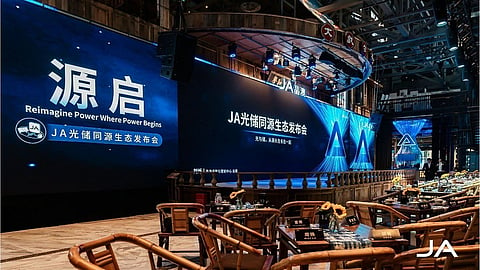


At an event in Chengdu, China, on 16 November, JA Solar unveiled its Same-Origin Solar and Storage Ecosystem, an approach in which the company designs its solar, storage, energy management and service offerings together from the outset. JA has estimated that, as a result, the time for deployment and commissioning can be shortened by 20% to 30%.
Click here for a quick project snapshot
JA Solar, a China-based manufacturer of solar modules and energy storage systems, unveiled its Same-Origin Solar and Storage Ecosystem at an event in Chengdu on 16 November. The launch was attended by representatives of industry associations, research institutions, customers and certification bodies.
The idea behind the approach is a simple one. Rather than bringing separately developed products together at a later stage, JA plans its solar, energy storage, intelligent energy management and customer service as one from the outset. In his opening address, JA President Yang Aiqing said that a closer integration of solar and storage was a natural next step, as both industries have matured. Liu Shuo, who is the President of the Brand & Marketing Center at JA, noted that excellent solar modules and storage equipment do not automatically make an excellent system. For that reason, he said, compatibility, dispatch and accountability must be addressed at the design stage.
To put the approach into practice, the company has built it on three core capabilities, which Guo Yafei, the Co-President of the Regional Operations Center at JA, outlined at the event. They are unified control and dispatch, coordinated green power management and unified service, and they share a single hardware architecture, software platform and commissioning process. When the approach is compared with separately assembled systems, JA has estimated that it can improve system efficiency by 2% to 3% and shorten deployment and commissioning time by 20% to 30%. It has also estimated that lifecycle project management costs can be reduced by 30%, and that operation and maintenance costs can be lowered by 10% to 20%.
JA ESS, which is the energy storage business of JA, unveiled its own solutions at the same event, and they are built on the same approach. Eight application areas are covered, from AI data centers and utility-scale projects to agriculture, mining and residential energy. JA has pointed to deployments in Italy, northwestern China, the Democratic Republic of the Congo and Inner Mongolia. Its modeling of a typical commercial and industrial project, meanwhile, indicates a 28.3% shorter payback period and a 36.5% increase in the internal rate of return (IRR).
The question of how such gains can be verified was also taken up at the event. Bai Yiqi of TÜV Rheinland Greater China outlined plans to develop standards for verifying the value of integrated solar and storage systems, which will cover plant-level performance, system coordination, lifecycle reliability and asset value. The certification body is also to prepare a joint white paper with JA. At an industry roundtable, the participants called for a shift from connecting single devices to designing and managing whole systems, which, they said, would need shared objectives, clear accountability and consistent standards of evaluation.
Looking ahead, JA plans to bring the ecosystem to more than 180 countries and regions through a network of over 5,000 partners.