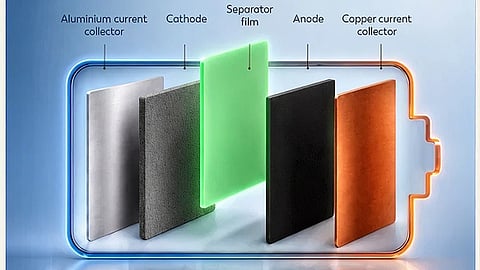


A wholly owned subsidiary has been incorporated by TCPL Packaging, an India-based packaging manufacturer, for the manufacture of lithium-ion battery separator films. About INR 125 crore is to be invested over 18 months in its first plant, which will have a capacity of 70 million square metres a year, enough for 6-8 GWh of cell production.
Click here for a quick project snapshot
An update on the separator film project of TCPL Packaging, an India-based packaging manufacturer, has been given in the transcript of its Q2 FY27 earnings call, which was filed on 11 November. The business has been placed in TCPL Energy Materials Limited, a wholly owned subsidiary, and that company was incorporated on 24 September 2026.
The project had been announced in August, when the company said that it would invest about INR 125 crore over the next 18 months. For that sum, the first plant is to produce 70 million square metres of separator film a year, which is enough for 6-8 GWh of cell production. Within five to seven years, the capacity is to be raised to about 500 million square metres, and that would serve around 50 GWh of cell manufacturing in India.
How the film will be made was explained by Vidur Kanoria, an executive director of TCPL. The company is to begin with water-based coating machines, and it will later integrate backward into extrusion, at which stage the base film will be made in-house from polyethylene resin. The plant is being planned for LFP and NMC chemistries alike, as well as for cylindrical, prismatic and pouch cells. He put the need at 8 million to 12 million square metres of separator for each GWh of cells, and its share at 6% to 10% of the cost of a cell.
The output is to be sold to the companies building cell factories in India, among them Reliance, Amara Raja, Exide and Ola, and exports are also to be considered. Reliance has said that the first phase of its 40 GWh BESS and cell giga factory is to be commissioned this year. According to Kanoria, the customers will not sign contracts until the TCPL plant is up, but the talks held so far have met with a good response.
The financial outlook was given by Akshay Kanoria, who is also an executive director. He said that the current investment could bring revenue of up to INR 200 crore, and that the business could reach INR 1,000 crore to INR 2,000 crore at full scale, with the ramp-up to be carried out in phases.
The plan has been made at a time when the supply chain for battery materials is still concentrated outside India. Wood Mackenzie has estimated that China controls between 85% and 98% of global capacity across the cathode, anode, separator and electrolyte supply chains, and its research in August counted 2 GWh of commissioned cell manufacturing capacity in India. Vidur Kanoria said that separator prices had risen globally, and that cell makers in India would wish to source the material locally as they scale up.