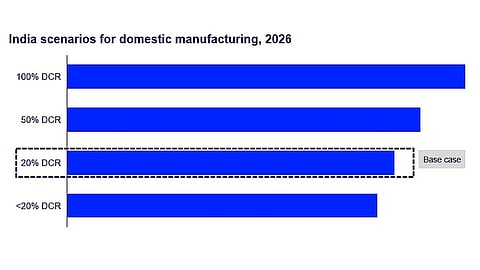

Less than 1% of India's approximately 260 GWh battery demand pipeline is currently covered by domestic manufacturing. Wood Mackenzie estimates the country remains 10 to 15 years from a globally competitive, self-sufficient cell industry, despite more than 226 GWh of manufacturing capacity being announced through 2035.
Click here for a quick project snapshot
Wood Mackenzie, a UK-based energy research and consultancy firm, has published research estimating that India remains 10 to 15 years from developing a globally competitive, self-sufficient battery cell industry. Domestic battery manufacturing currently accounts for less than 1% of an approximately 260 GWh demand pipeline from competitive tenders in 2026. India has 2 GWh of commissioned cell manufacturing capacity, compared with China's cumulative 2,695 GWh, while more than 226 GWh of domestic cell capacity has been announced for construction through 2035.
The research attributes the gap to execution delays, financial viability challenges and dependence on Chinese and Korean technology licences. China controls between 85% and 98% of global capacity across cathode, anode, separator and electrolyte supply chains. Wood Mackenzie expects India to focus first on downstream localisation, including containers, energy management systems, SCADA and battery packs, over the next two to three years. New grid-scale BESS tenders apply a 20% domestic content requirement.
Wood Mackenzie modelling indicates that increasing domestic content requirements from less than 20% to 100% would add about a 30% total CAPEX premium to a benchmark 100 MW, 2-hour BESS project. Locally manufactured cells are expected to cost 25-40% more than imported cells because of limited scale, higher financing costs and an underdeveloped supplier ecosystem. The research nevertheless calculates a 154% cost advantage over Japan and a 9% advantage over South Korea. Cell manufacturing is expected to develop progressively with imported inputs over the next two to five years, while full refining capabilities would take more than ten years to establish.
Only four players have deployed gigafactories in India as of 2026, and the pending players remain in planning or early production. Wood Mackenzie estimates that a 5 GWh facility operates at -10% EBITDA, with breakeven achievable at 10 GWh and positive margins requiring at least 20 GWh. Nearly all players depend on Chinese or Korean technology licences, which the research says limits control over pricing and supply chains.
