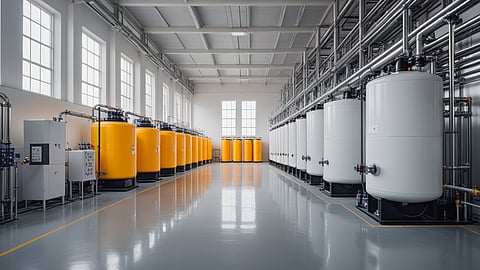


Green Energy Storage (GES), an SME in Trentino, Italy, that makes flow batteries for stationary storage, has received €10 million in financing from Intesa Sanpaolo. The funds are to help the company scale up its hydrogen-manganese battery and to put its first large-scale installations into service under real operating conditions.
Click here for a quick project snapshot
Intesa Sanpaolo, an Italy-based banking group, has provided €10 million in financing to Green Energy Storage (GES), a small and medium-sized enterprise (SME) in Trentino that makes flow batteries for the stationary storage of renewable energy. The financing was announced by the bank on 23 November 2026.
The financing, which has been set up as a structured finance transaction, was arranged by the Banca dei Territori division of the bank, in cooperation with its IMI Corporate & Investment Banking division. According to the bank, the money is to be used for the staff, materials and facilities that GES needs to scale up its hydrogen-manganese battery, which is being developed under the Important Projects of Common European Interest (IPCEI) programme.
The funds are also to allow GES to run its first large-scale installations under real operating conditions. According to the bank, this stage would advance the technology, and it would open the way to the certification of the product and then to its industrial production.
As for the technology, the battery is based on a hybrid architecture of a gas and a liquid, and it uses a single electrolyte. In an interview with Corriere della Sera, Salvatore Pinto, the president and majority shareholder of GES, said that manganese is the only raw material of the battery, and that the company turns it into manganese sulfate. The chemistry has been patented.
On its website, GES has stated that the battery works at room temperature and that its power and energy modules are independent of each other, so that a system can be designed to suit its use. The company has forecast more than 12,000 cycles, or a life of 15 to 20 years, and it has said that the modular design allows a system to be scaled up to megawatt size.
The company, which is based in Povo in the province of Trento, had planned its first demonstrator of 1 kW for the end of 2025. It has set itself the aim of reaching technology readiness level (TRL) 6 by the end of 2026.