
News Synopsis
PROJECT SNAPSHOT
Project Name – BRPL 97.5 MW/195 MWh BESS System.
Developer / Owner – BSES Rajdhani Power Ltd. is leading the proposed BESS procurement.
Project Type – Grid-scale BESS for Delhi’s distribution network.
Capacity – 97.5 MW/195 MWh cumulative storage capacity.
Location – Five 66/11 kV grid stations in Delhi: Harinagar, Sagarpur, DTL Pappankala 2, Bindapur and G4 Dwarka.
Technology Used – 2-hour BESS designed for short peak-demand support.
Project Status – Approved in-principle for competitive bidding by DERC.
Purpose / Use Case – Planned for peak shaving, energy arbitrage, ancillary services, grid support, resource adequacy and backup supply.
Expected Output / Benefit – Expected to serve about 266,060 consumers and deliver about INR 88.35 crores in annual benefits over 12 years.
Agreement / Contract Details – DERC allowed BRPL to start bidding under Ministry of Power BESS guidelines dated March 10, 2022.
Companies Involved – BRPL, DERC, TERI as bid manager and Delhi Transco Limited as the upstream network entity.
The Delhi Electricity Regulatory Commission (DERC) has allowed BSES Rajdhani Power Ltd. (BRPL) to begin competitive bidding for the installation of a 97.5 MW/195 MWh grid-scale BESS in South and West Delhi.
BRPL sought approval because the proposed BESS falls under regulated power procurement and distribution planning. As a distribution licensee, BRPL needs the Commission’s approval before selecting an entity to commission, own and operate the storage system. The project tariff expected savings and consumer impact will later be reviewed through BRPL’s power purchase cost and Aggregate Revenue Requirement.
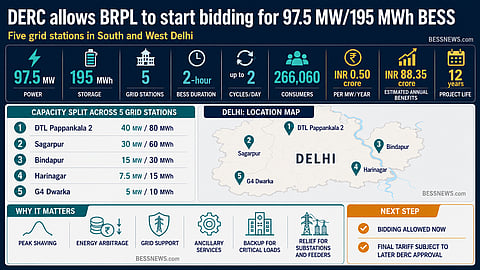
The proposed BESS will be installed across five 66/11 kV grid stations: Harinagar, Sagarpur, DTL Pappankala 2, Bindapur and G4 Dwarka. The storage capacity will be distributed across these locations instead of being placed at a single site.
DTL Pappankala 2 will receive the largest share at 40 MW/80 MWh, followed by Sagarpur at 30 MW/60 MWh, Bindapur at 15 MW/30 MWh, Harinagar at 7.5 MW/15 MWh and G4 Dwarka at 5 MW/10 MWh.
The project will not be built directly by BRPL using its own capital expenditure. BRPL will select another entity through competitive bidding and the selected entity will commission, own and operate the battery storage system. The bidding will follow the Ministry of Power’s BESS procurement guidelines issued on March 10, 2022, and The Energy and Resources Institute will act as the bid manager.
BRPL has planned the project as a two-hour BESS, allowing the system to supply rated power for about two hours when fully charged. The utility said the design matches Delhi’s distribution-level needs, where grid stress occurs for short periods. BRPL also said higher power capacity is more useful at these locations than longer-duration storage, especially because space is limited inside the grid stations. The battery will be required to perform two cycles of charging and discharging per day.
The proposed system is expected to serve about 266,060 consumers in BRPL’s licensed area. BRPL said the BESS can help reduce loading at existing substations, ease pressure on upstream Delhi Transco Ltd. feeders, and support energy arbitrage, ancillary services, resource adequacy and backup supply to critical loads.
BRPL has estimated a capacity charge of INR 0.50 crore per MW per year, excluding taxes. For the full 97.5 MW capacity, the estimated annual capacity charge would be about INR 48.75 crore before taxes, subject to the final price discovered through bidding. The utility also projected about INR 88.35 crore in annual benefits over the 12-year project life, mainly from peak-hour savings, ancillary services and deferred distribution network expenditure.
DERC noted that the financial case mainly depends on energy arbitrage, where the BESS charges during lower-cost periods and discharges during peak hours when power is costlier. Since future power exchange prices may change over the 12-year project life, the Commission has only allowed BRPL to begin the bidding process for now.
After the bidding process is completed, BRPL will need separate approval from DERC for the final tariff. The Commission will review the discovered price and its likely consumer impact before approving tariff adoption.
BRPL has already commissioned a 20 MW/40 MWh BESS at the Kilokari grid station. The utility referred to that project while proposing the new storage capacity, saying the earlier system had shown operational and commercial performance.
The approval allows BRPL to move ahead with another distribution-level battery storage procurement process in Delhi. The proposed project is expected to help BRPL manage peak demand, support grid operations and reduce power purchase costs where possible.