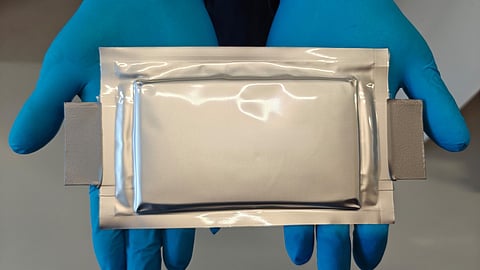


Pouch cells of 25 Ah with silicon-rich anodes, which were made in-house by Fraunhofer ISE, have been operated for more than 1,000 full cycles and have retained over 83 percent of their original capacity. The cells have reached 280 Wh/kg in a research format, and about 330 Wh/kg is expected once the format has been optimised for industry.
Click here for a quick project snapshot
Fraunhofer ISE, a Germany-based research institute for solar energy systems, has operated its in-house 25 Ah pouch cells with silicon-rich anodes for more than 1,000 full cycles, and the cells have retained over 83 percent of their original capacity. The test was carried out in the StrOboBatt project, and a gravimetric energy density of 280 Wh/kg was reached in a research cell format that had not been optimised. The result was announced by the institute on 20 October 2026.
Although silicon-rich lithium-ion batteries can offer high energy densities for electric mobility, aviation and stationary storage, their industrial use has so far been limited by a short cycle life. Dr. Lukas Dold, the team leader for battery materials technology and scaling at Fraunhofer ISE, has said: "More than 1,000 cycles with a capacity retention of at least 80 percent is considered an important performance target here." In an industrially optimised pouch format, an energy density of about 330 Wh/kg is expected.
Each of the full cells has been built with 40 layers from commercially available electrode foils, and it combines a silicon-carbon/graphite anode with a nickel-rich NMC cathode. The silicon-carbon composite has made up 51 percent of the anode active material, so that the anodes have reached a specific capacity of more than 1 Ah/g and an areal capacity of more than 5 mAh/cm². The cells were manufactured on a semi-automatic line in the cleanroom of the Center for Electrical Energy Storage, and they are now being used as reference cells for new materials, designs and operating conditions.
In addition, the effect of mechanical pressure has been studied, and the cells were charged and discharged within one hour at two axial contact pressures, 300 kPa and 1 MPa. According to Marc Kissling, the group leader for battery cell production and technology evaluation, the cells at 1 MPa have kept over 83 percent of their capacity, whereas the cells at 300 kPa have lost usable capacity much faster. The researchers have also observed a growing gap between the capacity at a low discharge rate and the capacity at 1C, which shows that real operating conditions must be considered as well.
Fraunhofer ISE is based in Freiburg, Germany, and it can investigate new battery materials along the whole process chain, from the fabrication of electrodes to the testing of large pouch cells. Its infrastructure includes batch mixing, roll-to-roll coating, pouch cell assembly, cell formation and electrochemical characterisation.