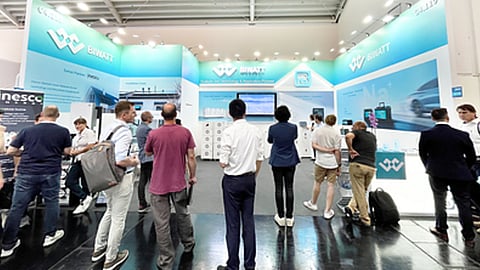

Shenzhen-based BIWATT launched the PowerNest R5 residential battery and PowerLake I3 commercial and industrial battery at Intersolar Europe 2026 in Munich, expanding its sodium-ion energy storage lineup. Both use BIWATT's in-house NFPP sodium-ion cell platform and are progressing UL1973 certification and UL9540A testing. The company said its sodium-ion products are now deployed across more than 20 countries, mostly in Europe.
Click here for a quick project snapshot
BIWATT, a Shenzhen-headquartered sodium-ion battery manufacturer, unveiled two new energy storage products, the PowerNest R5 and PowerLake I3, at Intersolar Europe 2026 in Munich. The launch expands the company's sodium-ion portfolio into new residential and C&I product lines, building on its existing PowerNest R2 and R3 batteries, which BIWATT said have already entered commercial delivery across international markets.
The PowerNest R5 is built on the same underlying battery platform as BIWATT's earlier products and is aimed at residential energy storage. BIWATT described the R5 as offering modular scalability and active balancing technology, along with what it calls intelligent battery optimization; the release does not disclose specific power or energy capacity, voltage, or cycle-life figures for the unit.
The PowerLake I3 extends BIWATT's sodium-ion platform into C&I applications, which the company said supports solar-plus-storage, backup power, and distributed energy projects. BIWATT described the I3 as offering flexible deployment options and intelligent maintenance capabilities, though again without specific kWh, kW, or voltage ratings disclosed in the release.
BIWATT said both products are built around a dedicated sodium-ion battery platform developed through direct involvement in cell-level design, which the company said lets it define performance, safety, and reliability requirements from early in the product development process, rather than integrating third-party sodium-ion cells. To support international market expansion, BIWATT said it is progressing UL1973 certification and UL9540A testing for its sodium-ion products; neither certification is described as complete as of the announcement.
BIWATT CEO Owen said the company's approach centers on cell-level innovation specifically engineered for energy storage applications, framing the R5 and I3 launch as an extension of that strategy. BIWATT said its sodium-ion products are currently deployed in more than 20 countries, primarily across Europe, which the company points to as evidence of growing commercial adoption of sodium-ion storage.
