

EXECUTIVE SUMMARY
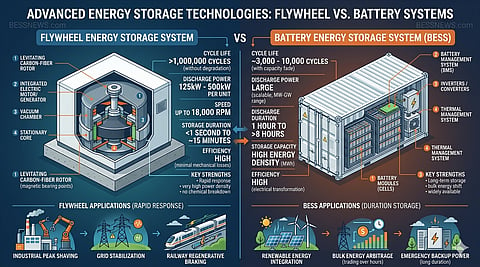
Adaptive Balancing Power is commercializing second-generation flywheel energy storage systems for industrial peak shaving, rail transport, hospital backup power and grid stabilization applications. The company’s systems use 850 kg levitating carbon-fiber rotors operating at up to 18,000 rpm inside vacuum chambers to deliver rapid-response, short-duration power support with high cycling capability. The technology complements battery energy storage systems by targeting high-power applications requiring fast charging and discharging within renewable-heavy energy systems.
Click here for a quick project snapshot
German start-up Adaptive Balancing Power is advancing the commercialization of second-generation flywheel energy storage systems (FESS) designed to deliver rapid-response power support for industrial facilities, rail networks, hospitals and grid stabilization applications across Europe and other international markets.
The company’s founders, Hendrik Bodenschatz and Nicolai Meder, initially conducted research on high-performance permanent magnets at the Technical University of Darmstadt in Germany. Established in 2016 as a university spin-off, the company focuses on high-speed kinetic energy storage systems that use magnetic levitation and vacuum environments to minimize friction losses and improve operational efficiency. The company’s technology is based on a levitating rotor system.
Flywheel energy storage is based on an old physics principle: rotating objects can store energy. Pottery wheels and spinning tops are best examples. According to this principle, without friction, a rotating object would continue moving indefinitely. In real conditions, friction gradually slows it down. Since the 1970s, researchers including NASA have worked on reducing these losses, helping advance modern flywheel storage systems.
FESS operate by converting electrical energy into rotational kinetic energy. Adaptive Balancing Power’s second-generation storage system is based on a freely levitating rotating unit. The unit consists of an electric motor weigh around 850 kg which is a carbon-fiber-based rotor suspended contact-free within a vacuum chamber using permanent magnets, which keep the system stably suspended while reducing mechanical losses. The rotor can reach speeds of up to 18,000 revolutions per minute.
Working of FESS
The operating principle is based on an electrical machine. An electric motor generates rotational movement through a magnetic field and accelerates a freely suspended, contactless flywheel mass inside a vacuum. The vacuum environment enables very high rotational speeds while minimizing friction losses.
In discharge mode, the rotating flywheel drives the electric motor as a generator by converting stored kinetic energy back into electrical energy. The motor and flywheel operate together as an integrated charge and discharge system. Higher output levels can be achieved by combining multiple motors.
Difference between FESS and BESS
Flywheel storage works differently from lithium-ion batteries, which are used in BESS. Instead of storing energy chemically, it stores energy as rotational motion. That reduces some of the aging issues linked to repeated charging cycles and lowers the impact of temperature changes. The technology is mainly used where fast bursts of high power are needed.
Flywheel systems are built for frequent and rapid charging cycles. Unlike many battery technologies, they can handle repeated charging and discharging with limited performance loss over time. The absence of chemical reactions reduces many common aging effects seen in lithium-ion batteries. Most flywheel systems rely on mechanical parts made from metal, copper and carbon fiber. Flywheels and batteries are used for different purposes in an energy system. Most projects use these technologies for different roles within the same energy system, with each technology handling specific grid and storage demands.
Industries That Benefit from FESS
Industrial peak shaving represents one of the company’s primary target applications. Manufacturing operations such as robotics facilities, injection moulding plants and automated production lines frequently experience short-term power peaks that increase grid-related energy costs. Flywheel storage systems compensate for these fluctuations, relieve stress on the grid and reduce grid-related energy costs at the same time.
Hospitals and critical infrastructure facilities are other areas to focus. In these areas, uninterrupted electricity supply is essential for heating systems, emergency operations and backup power support at all times. Flywheel systems can provide immediate power and stabilize the system during critical moments and bridge blackout scenarios when backup power sources are starting up. Discharge durations typically range from milliseconds to 15 minutes approximately.
The technology is also being deployed for grid stabilization services as renewable energy penetration increases across Europe. Multi-megawatt flywheel clusters can support frequency regulation and voltage stability by rapidly compensating for fluctuations caused by intermittent renewable generation sources such as wind and solar.
Rail transport infrastructure is another major deployment segment. In metro and urban railway systems, regenerative braking energy generated when train slow down can be captured and temporarily stored in flywheel systems before being reused to accelerate other trains when needed. Beyond energy savings, the systems help stabilize railway power networks and can reduce the need for additional substations and overhead line expansion in densely used transport corridors.
Flywheel storage is attracting attention of markets as renewable energy systems become more complex and require faster grid balancing support. Integrated renewable energy systems (IRES) combine several power sources, including solar, wind, micro-hydro, biomass and biogas with energy storage technologies. In remote and off-grid projects, the flywheel storage systems help improve reliability and lower the use of diesel and other fossil fuels.
Battery energy storage systems are primarily considered suitable for long-duration storage applications, whereas flywheel energy storage systems are mainly deployed for short-duration, high-power applications requiring rapid charging and discharging.