

EXECUTIVE SUMMARY
Sunwoda completed a large-scale fire test on its 5MWh Liquid Cooling ESS using five full-scale systems under ANSI/CAN/UL 9540A:2026 and CSA/ANSI C800:2025 standards. The test used 100% state of charge, 15 cm container spacing and disabled fire suppression to simulate extreme thermal runaway conditions. The results demonstrated successful fire containment without propagation, supporting safer high-density multi-container BESS deployments.
Click here for a quick project snapshot
Sunwoda Electronic Co., Ltd., founded in 1997 and headquartered in Shenzhen, China, manufactures lithium-ion batteries and energy storage systems for consumer electronics, electric vehicles and utility-scale ESS applications. The company operates across battery cell manufacturing, energy storage, power technology and smart hardware businesses.
In September 2023, Sunwoda Energy launched the NoahX 2.0 5MWh liquid-cooled energy storage system. Built with 314Ah LFP cells, the 20ft container-based system offers a cycle life of 12,000 cycles. The company said the BESS uses liquid-cooling CTP 2.0 technology.
In early May 2026, Sunwoda has completed a large-scale fire test for its 5MWh liquid cooling energy storage system (ESS), validating the system’s fire containment performance under high-density deployment conditions.
The test comes as energy storage systems continue moving toward higher capacity and energy density, increasing the importance of project-level safety validation. Industry standards such as UL 9540A and CSA C800 are also driving more application-focused testing for utility-scale storage projects.
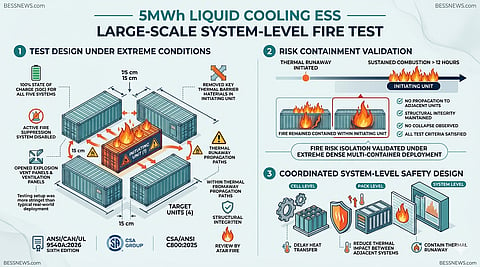
The fire test involved five full-scale 5MWh liquid cooling ESS containers, including one initiating unit and four adjacent target units. The containers were positioned with only 15 cm spacing, creating a denser arrangement than conventional project deployments. All systems were tested at 100% state of charge, while active fire suppression systems were disabled to increase test severity.
To further intensify the test conditions, explosion vent panels and ventilation panels in the initiating unit were opened, while selected thermal barrier materials were removed to simulate an extreme thermal runaway scenario.
The test was conducted in accordance with ANSI/CAN/UL 9540A:2026 Sixth Edition and CSA/ANSI C800:2025 standards. CSA Group conducted the test, while the results were reviewed by a fire protection engineer from Atar Fire.
During testing, the initiating unit experienced thermal runaway and continued combustion for more than 12 hours. According to the company, the fire remained contained within the initiating unit, with no thermal propagation to adjacent ESS containers. Structural integrity was also maintained throughout the test without collapse.
Sunwoda stated that the results validate the fire containment capability of its liquid cooling ESS in dense multi-container deployment environments. The company added that multiple system-level protection measures across cells, PACKs, and system architecture were designed to reduce heat transfer and limit thermal impact between adjacent units.
As battery storage projects grow larger, fire containment and thermal management are becoming increasingly important for system developers and operators. Sunwoda said the company will continue improving safety measures across its energy storage portfolio.