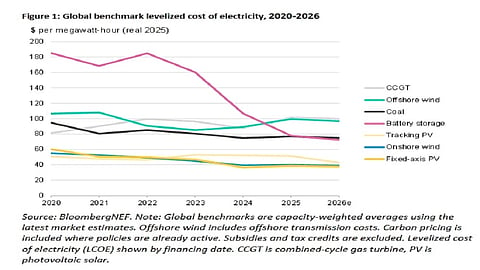

BloombergNEF’s Levelized Cost of Electricity 2026 report indicates that 4-hour battery storage costs declined 27% year-on-year to $78/MWh in 2025, reaching a record low. In contrast, benchmark costs for solar, onshore wind, offshore wind and gas-fired generation increased due to supply-chain constraints and higher equipment prices. Solar-plus-storage additions totaled 87 GW, while further cost reductions are projected through 2035.
PROJECT SNAPSHOT
U.S.-based research firm, Bloomberg New Energy Finance (BloombergNEF) has released its Levelized Cost of Electricity (LCOE) 2026 report, reviewing cost developments across clean power and thermal generation technologies in 2025. The analysis showed that battery storage recorded the steepest decline among major technologies, while benchmark costs for solar, wind and gas-fired generation increased.
According to BloombergNEF, the global benchmark cost for a 4-hour battery storage project fell 27% year-on-year (YoY) to $78/MWh in 2025, the lowest level recorded since tracking began in 2009. The decline was attributed to higher manufacturing competition and improvements in system design efficiency.
In comparison, the benchmark costs for a fixed-axis solar PV project rose 6% to $39/MWh. It reached $40/MWh for onshore wind and $100/MWh for offshore wind globally. Prices for these clean technologies rose owing to supply chain constraints, project location factors and market adjustments in mainland China. Offshore wind supply tightness continued to place upward pressure on costs in multiple markets.
Thermal power became more expensive in 2025. Rising equipment prices for new gas and coal plants increased the global levelized cost of electricity from combined-cycle gas turbines (CCGTs) up 16% to $102/MWh, the highest level ever recorded. BloombergNEF expects gas turbine prices to remain elevated in the near future with high demand from data centers.
The expansion of co-located renewable energy projects, particularly solar combined with battery storage, is contributing to continued declines in battery storage costs. In 2025, 87 GW of combined solar-plus-storage projects were installed, delivering power at an average benchmark cost of $57/MWh.
In mainland China, onshore wind retained a cost advantage despite the global benchmark rising 2% due to lower wind-speed project locations. Outside mainland China, onshore wind costs declined 4% in 2025. In the United States, wind power regained its position as the lowest-cost source of new-build electricity generation, overtaking gas-fired power for the first time since 2023, as turbine capital expenditures increased sharply.
The report is based on proprietary cost data covering more than 800 recently financed projects and models LCOE forecasts across 28 technologies in over 50 markets. The 2026 edition includes expanded analysis of battery storage economics, renewables-plus-storage configurations and additional market coverage across the Middle East and Africa.
Amar Vasdev, lead author of the report and senior energy economics associate at BloombergNEF, said that manufacturing overcapacity from the electric vehicle sector and improved system designs have reduced large-scale energy storage costs. He noted that 4-hour battery systems are now below $100/MWh in 6 markets, with further cost declines expected to support solar revenues and increase storage-led grid balancing.
He added that the growing demand from electrification and data centers is increasing competition, with solar and wind undercutting coal and gas in multiple regions, including the US, Canada, Asia-Pacific and parts of Europe.