

EXECUTIVE SUMMARY
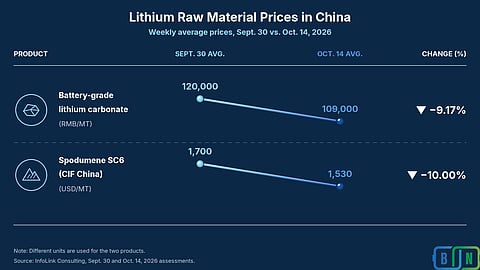
InfoLink’s latest assessment shows continued declines in lithium raw material and LFP energy storage cell prices in China. Battery-grade lithium carbonate fell 9.2% week over week to RMB 109,000/MT, while spodumene SC6 dropped 10.0%. LFP cell prices declined moderately, but electrochemical energy storage system (ESS) transaction prices remained stable.
Click here for a quick project snapshot
China’s battery energy storage supply chain recorded another week of declining lithium raw material prices, while energy storage cell prices edged lower and complete energy storage system (ESS) prices remained stable. According to InfoLink’s latest assessment, battery-grade lithium carbonate averaged RMB 109,000/MT, declining 9.2% week over week, within a trading range of RMB 106,000–112,000/MT. Spodumene concentrate (SC6, CIF) averaged $1,530/MT, falling 10.0%, with prices ranging between $1,480–1,580/MT.
Despite increasing production schedules for lithium iron phosphate (LFP) cathode materials, uncertainty remains over whether battery demand can absorb additional output. Lower lithium prices have encouraged some downstream purchasing inquiries, although actual transaction volumes remain limited. InfoLink expects lithium carbonate prices to fluctuate between RMB 100,000–120,000/MT in the near term.
The decline reflected expectations of recovering lithium supply and uncertainty surrounding downstream demand. On October 8, the Jianxiawo lithium mine project in Jiangxi entered the public notice stage for the proposed acceptance of its environmental impact assessment application. Although additional approvals remain necessary before production resumes, expectations of increased Chinese lithium supply strengthened.
Meanwhile, some Brazilian lithium mining companies resumed production. Zimbabwe reiterated on October 9 that restrictions on lithium concentrate exports would proceed in January 2027 without further postponement.
China’s LFP energy storage cell prices also declined moderately. Average transaction prices for 100 Ah cells fell 1.8% to RMB 0.420/Wh. Prices for 280 Ah and 314 Ah cells decreased 0.7% to RMB 0.360/Wh each. Inventory accumulation and relatively ample supply increased pressure on 100 Ah cell manufacturers, while ongoing utility-scale project deliveries supported larger cell formats.
However, complete ESS transaction prices remained unchanged. Two-hour DC-side liquid-cooled systems averaged RMB 0.49/Wh, while one-hour, two-hour and four-hour AC-side systems averaged RMB 0.84/Wh, RMB 0.58/Wh and RMB 0.53/Wh, respectively.
Longer contract negotiations, existing delivery commitments and stable supporting equipment costs have limited the immediate transmission of lower raw material prices into ESS quotations.
Industry procurement activity continued. On October 12, Star New Energy launched framework procurement for 10 GWh of LFP cells for 2027, including 314 Ah and 587 Ah-and-above formats. Separately, Inner Mongolia Gaoju Energy Storage announced contract awards for 900 MW/3.6 GWh of grid-forming power conversion systems.
These developments highlight growing interest in higher-capacity cells and grid-forming technologies, even as price negotiations intensify across the energy storage supply chain.