
News Synopsis
PROJECT SNAPSHOT
Project: ENGIE Spain & France BESS Portfolio
Capacity: 388 MW / 1.32 GWh
Spain Projects: Álora (78 MW / 312 MWh) and Tarifa (200 MW / 800 MWh)
France Project: Castelnau d’Aude BESS (110 MW / 220 MWh)
Location: Spain (Andalusia) and France (Aude)
Developer: ENGIE
Storage Duration: Up to 4 hours (Spain); 2 hours (France)
Status: Spain acquired; construction from 2027, commissioning in 2028. France under construction, commissioning in summer 2027
Total European BESS Portfolio: More than 1 GW across eight countries
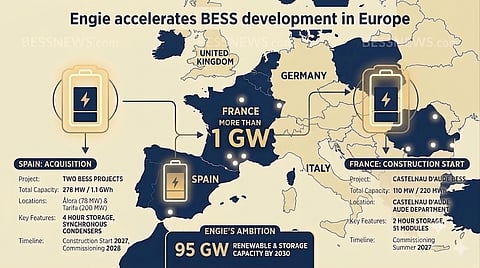
French multinational electric utility company ENGIE is scaling up its European battery footprint with a pair of new utility-scale developments. The company bought two standalone BESS in Spain combining for 278 MW / 1.1 GWh of capacity. Meanwhile, ENGIE initiated the development of a 110 MW / 220 MWh plant in the south of France, which was to become the first independent battery plant in the home market for the company.
The Spanish plants are situated in the Andalusia province of Spain and feature individual capacities of Álora – 78 MW / 312 MWh and Tarifa – 200 MW / 800 MWh. Operating on a four-hour duration cycle, these standalone facilities rank among Spain's largest current battery developments and join ENGIE's existing 1.8 GW domestic renewable portfolio.
Because renewable energy output can change rapidly, both Spanish sites will use synchronous condensers to keep the local grid steady. This equipment adds physical weight—or mechanical inertia—to the system and regulates how power flows through the lines to prevent blackouts. Crews will begin construction on these sites in 2027 and are expected to turn the batteries on in stages throughout 2028.
In France, construction is going on at a battery storage plant rated at 110 MW / 220 MWh that will be situated in the southern town of Castelnau d’Aude. The project, which covers a two-hectare area near a power grid connection point, consists of 51 battery units. The system will provide two hours of dispatchable energy storage and is scheduled to enter commercial service by summer 2027.
The facility represents ENGIE’s inaugural BESS development within its domestic market, where its operational solar and onshore wind capacity already totals 5.3 GW. Integrating this storage component is intended to improve renewable energy grid absorption and supply critical flexibility services to the French power network.
Battery energy storage systems have become an integral part of the European electricity network due to the fast-growing renewable energy sources. This technology provides energy time-shifting, frequency regulation, and balance of load and production functions to reduce renewable energy's unpredictability and improve electricity supply's reliability.
The new Spanish and French assets push ENGIE’s European battery pipeline past the 1 GW mark. Currently, the utility is tracking around 700 MW of storage power that is deployed or under deployment in eight countries, which include Belgium, Germany, Italy, the Netherlands, Romania, Spain, France and the United Kingdom.
These latest projects directly support ENGIE’s overarching target of reaching 95 GW of global renewable and storage capacity by 2030. The company wrapped up 2025 with 57.2 GW of installed capacity and is maintaining this momentum via new generation and flexibility infrastructure across its core international markets.