
News Synopsis
PROJECT SNAPSHOT
Project: Khavda BESS
Capacity: 3.37 GWh
Location: Khavda, Gujarat, India
Developer: Adani Green Energy Ltd
Technology: Lithium-ion BESS
Status: Commissioned
Timeline: Delivered within 10 months
Renewable Hub: Part of 30 GW Khavda renewable energy project
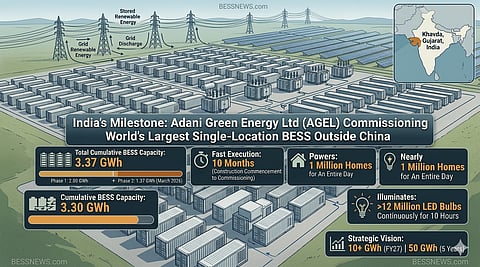
Adani Green Energy Limited (AGEL), an Indian renewable energy company has commissioned a 3.37 GWh BESS at Khavda in Gujarat. This project is expected to mark as world’s largest single-location battery storage deployment outside China and also other countries. The current capacity includes 1.37 GWh of capacity which was already added in March 2026. Along with this capacity, the company’s total operational BESS capacity at the proposed site is 3.37 GWh.
The project was completed within 10 months from the start of on-site construction, which was said to be one of the fastest utility-scale battery storage deployments globally. The storage facility has been integrated into AGEL’s renewable energy complex at Khavda, where the company is developing a total of 30 GW renewable energy park by 2029. Among this planned capacity, 9.9 GW was already operational within the energy park.
This system uses lithium-ion batteries and an energy management system in order to optimize the performance of the system. The proposed BESS plant will be located in 538 sq km area of the Kutch salt desert. This area is completely barren and has no vegetation or population living in this area. This allows for utility-scale deployment without displacing communities or harming agricultural land. Energy production from renewable sources changes depending on time, climatic conditions, seasons and geographical position. The facility in these types of locations can help overcome such challenges because it accumulates surplus energy and provides it when needed.
According to the company, the proposed capacity can store enough renewable electricity to supply nearly one million homes for a full day. The system is also capable of supporting the peak electricity demand of cities such as Indore and Chandigarh or the entire state of Goa, while powering more than 12 million LED bulbs continuously for 10 hours.
Sagar Adani, Executive Director of AGEL said battery storage infrastructure is becoming important for managing higher renewable energy capacity across India’s grid. On top of this, the new BESS system is set to build a flexible and efficient clean energy system by generating energy based on renewables round the clock.
AGEL announced that it aims to deploy additional storage of 10GWh in the FY27 and also grow the storage capacity to a total of 50GWh in the upcoming five years. The growth in storage capacity is an indication of the rising significance of utility-scale storage systems, especially in the context of a grid reliant on renewable energy whose generation fluctuates based on weather conditions and time of day.