

EXECUTIVE SUMMARY
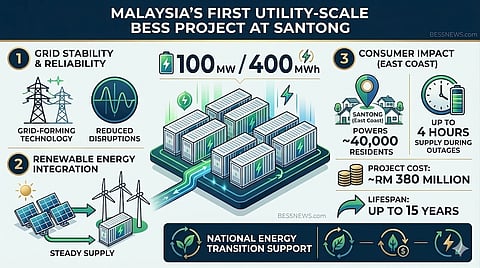
Tenaga Nasional Berhad has commissioned the 100MW/400MWh Santong battery energy storage system in Malaysia at a cost of about RM380 million. The project uses grid-forming technology, began operations on April 17 and can supply electricity for up to four hours, supporting around 40,000 residents on the East Coast. The system is Malaysia’s first “smart energy bank” and is expected to strengthen grid stability while enabling higher renewable energy integration.
Click here for a quick project snapshot
Malaysia has commissioned its first BESS project at Santong. The facility was developed by Tenaga Nasional Berhad (TNB), provides 100 MW of output capacity and 400 MWh of storage. The project is intended to help improve grid stability and support the integration of more renewable energy into Malaysia’s power system.
TNB chairman Abdul Razak said the Santong BESS facility was constructed on 1.2-hectare site located at the 132/33kV Main Intake Substation (PMU) in Santong. The facility is expected to strengthen the reliability and stability of Malaysia’s electricity supply system, particularly in the East Coast region. According to him, the BESS facility is capable of responding rapidly to imbalances between electricity supply and demand, allowing the system to play an important role in maintaining grid stability and supporting uninterrupted power supply operations. The development forms part of the country’s major energy transition plans under the National Energy Transition Roadmap (NETR).
According to Fadillah, Minister of Energy Transition and Water Transformation, Santong BESS project is one of the country’s earliest large-scale utility battery storage initiatives designed to support the share of renewable energy in Malaysia’s electricity mix.
The project, which cost around RM380 million, officially started operations on April 17 and is designed to operate for up to 15 years. Fadillah said the project demonstrates TNB’s ability to deliver major grid infrastructure projects quickly. He noted that the battery storage system can provide up to four hours of electricity during outages. The facility is expected to support electricity needs of about 40,000 residents in East Coast region.
The Santong BESS project is Malaysia’s first “smart energy bank” connected to the national grid using grid-forming technology. The project will also act as a learning platform for the local energy sector, helping companies and utilities gain experience in operating and integrating large-scale battery storage systems.