
News Synopsis
PROJECT SNAPSHOT
Project: Ford Energy–EDF power solutions framework agreement
Capacity: Up to 4GWh annually / 20GWh total
Location: United States
Companies: Ford Energy and EDF power solutions North America
Technology: DC Block BESS
Battery Chemistry: 512Ah lithium iron phosphate (LFP) prismatic cells
Duration: 2-hour and 4-hour configurations
Delivery Timeline: Starting from 2028
Application: Utility-scale grid storage and power system support
Status: Framework agreement signed
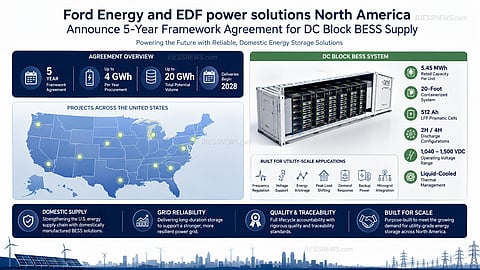
Ford Energy, a subsidiary of Ford Motor Company has entered into a long-term supply arrangement with EDF power solutions North America, an entity of the EDF Group, that could provide up to 20 GWh of BESS supplied for grid-scale projects across the US over the next five years.
The agreement allows EDF power solutions to source as much as 4 GWh of Ford Energy’s DC Block BESS platform annually beginning in 2028. The systems are expected to support EDF’s expanding utility-scale storage pipeline as demand for large-scale energy storage continues to increase in the North American market.
The partnership is intended to secure US-made battery storage equipment for large-scale projects supporting grid reliability and longer-duration operations, while giving EDF power solutions improved long-term supply visibility for future deployments.
Lisa Drake, president, Ford Energy said the partnership is focused on supplying utility-scale battery storage systems with consistent manufacturing, long-term service support and clear supply-chain tracking.
Tristan Grimbert, CEO of EDF power solutions North America said supply-chain reliability and product quality remain critical as the company continues to expand its storage portfolio. He added that Ford Energy’s emphasis on domestic manufacturing, traceability and lifecycle support aligns with EDF’s operational standards and provides the supply visibility needed to support deployment targets tied to the energy transition.
The DC Block system offered under the agreement is a 20-foot containerized storage unit with a rated energy capacity of 5.45 MWh. The system is built using 512 Ah lithium iron phosphate (LFP) prismatic battery cells and is available in both 2-hour and 4-hour duration configurations depending on project requirements.
According to the companies, the storage platform operates within a voltage window of 1,040 VDC to 1,500 VDC and includes integrated liquid-cooling technology for thermal management. The systems are intended for a range of utility-scale applications such as frequency regulation, voltage stabilization, energy shifting, demand response, backup power and microgrid support.
The agreement comes as utilities and developers across the US continue to expand battery storage investments to improve grid flexibility and support higher shares of renewable energy generation. Growing demand for domestically supplied storage technologies has also intensified following increased focus on supply-chain resilience and long-term operational performance in the energy sector.