

EXECUTIVE SUMMARY
InfoLink Consulting reported further declines in lithium carbonate, spodumene and LFP energy storage cell prices in China. Two-hour DC-side storage system prices fell by 1% WoW, while AC-side system prices remained stable. Weak residential demand, recovering lithium supplies and increasing competition among manufacturers continue to pressure the energy storage supply chain.
Click here for a quick project snapshot
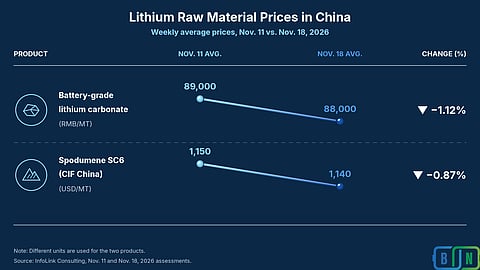
A market research and consulting firm, InfoLink Consulting's latest market assessment has shown a further decline in lithium and lithium iron phosphate (LFP) energy storage cell prices in China. Battery-grade lithium carbonate averaged RMB 88,000/MT, down 1.4% week-on-week (WoW), while spodumene concentrate prices fell by 0.9% to $1,140/MT. Energy storage system (ESS) prices remained largely unchanged except for slight decline in two-hour DC-side systems.
Lithium supplies in China are expected to improve following the approval of the environmental impact assessment for the Jianxiawo lithium mining project on October 30. Lithium ore imports have also increased, while shipments from Australian mines are gradually recovering. Chile exported 23,300 MT of lithium salts in October, an increase of 17% month-on-month (MoM). Exports to China rose by 6.5% to 14,300 MT. Meanwhile, Zimbabwe remains on schedule to introduce local mineral processing requirements in January 2027, although uncertainty remains over future ore exports.
Demand from utility-scale energy storage projects has remained relatively steady while residential storage and electric vehicle battery demand continue to be weak. Lithium carbonate inventories could begin to rise in December if operations at the Jianxiawo mine resume as expected.
The average price of 100 Ah LFP cells fell by 0.6% WoW to RMB 0.400/Wh. Both 280 Ah and 314 Ah cells recorded a 0.7% decline, averaging RMB 0.345/Wh. Several manufacturers have lowered their quotations to secure new orders. Although existing utility-scale projects continue to support demand for larger-capacity cells, increasing supply and competition among manufacturers are limiting the chances of a near-term price recovery.
Prices for two-hour DC-side liquid-cooled containerised ESS fell by 1% to RMB 0.48/Wh. One-hour, two-hour and four-hour AC-side systems remained unchanged at RMB 0.84/Wh, RMB 0.58/Wh and RMB 0.53/Wh, respectively. Equipment costs, including power conversion systems, voltage step-up equipment, thermal management and fire protection, have helped keep AC-side system prices stable.
On November 13, the two top-ranked bidders for PowerChina Huaxu New Energy's 200 MW/800 MWh standalone semi-solid-state storage project quoted RMB 0.528/Wh and RMB 0.509/Wh, respectively. The tender covers equipment supply only. Given the project's specific technical requirements, these quotations cannot be directly compared with conventional ESS prices.
China's National Development and Reform Commission (NDRC) and National Energy Administration (NEA) have set a target of 300 GW of new-type energy storage capacity by 2030, with an average storage duration of around three hours. While the policy is expected to support long-term demand, near-term prices will largely depend on raw material costs, project returns and competition among suppliers.