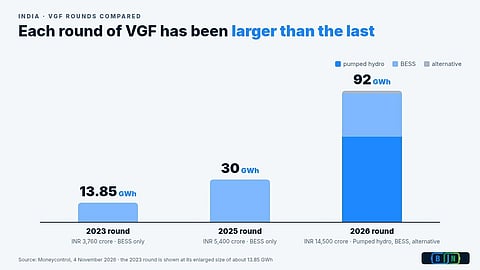


In India, 92 GWh of grid-scale energy storage is to be developed by FY31 under a viability gap funding scheme of INR 14,500 crore that the Union Cabinet has approved. Of that capacity, 60 GWh has gone to pumped hydro, 30 GWh to BESS and 2 GWh to other technologies, and each BESS project must carry 40% domestic content.
Click here for a quick project snapshot
India's Union Cabinet has approved INR 14,500 crore of viability gap funding (VGF) for 92 GWh of grid-scale energy storage, which is to be built by FY31. The approval was given on 4 November 2026, and the storage should allow the grid to carry more of the country's solar and wind power.
The capacity has been divided among three technologies. Pumped hydro storage will account for 60 GWh, while BESS will account for 30 GWh and alternative storage technologies for the remaining 2 GWh. The projects are expected to draw a total investment of INR 97,600 crore, and the government will extend its financial support across the five years from FY27 to FY31.
The capacity is to be awarded through tariff-based competitive bidding. Under the scheme, public and private sector distribution companies will be eligible for VGF on their battery storage and pumped hydro projects, whereas the alternative storage projects may be taken up by public and private sector entities. Every BESS project will, in addition, have to meet a minimum domestic content requirement of 40%, which the government has said is meant to encourage indigenous manufacturing and to reduce the country's dependence on imported components.
The scale of the programme is considerable. When built, the new capacity would amount to 170% of the grid-scale storage that India now has in operation. It would also meet about 22% of the 411.4 GWh of energy storage that, according to the Central Electricity Authority's National Electricity Plan, the country will need by 2031-32, of which 236.22 GWh is expected to be BESS and 175.18 GWh pumped hydro.
The scheme follows two earlier rounds of VGF, both of which were confined to battery storage. The first of them was approved by the Cabinet in September 2023, with INR 3,760 crore for 4 GWh of BESS, and it was later enlarged to about 13.85 GWh as battery prices came down. The second came from the Power Ministry in June 2025, when VGF was extended to a further 30 GWh with INR 5,400 crore from the Power System Development Fund. The new round is, therefore, the first to cover pumped hydro and alternative technologies.
The earlier rounds have already been carried through to projects on the ground. In Maharashtra, Oriana Power has won MSEDCL orders for 900 MW of BESS, and it expects INR 324 crore in VGF from the Power System Development Fund. In Tamil Nadu, the 250 MW/500 MWh BESS of NLC India Renewables, whose foundation stone was laid in October, has likewise been backed by VGF. The Cabinet had also approved the Green Energy Corridor Phase III in October, under which INR 50,000 crore has been allotted to 50 GWh of BESS.