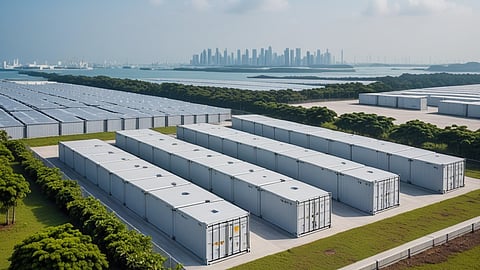


Singapore's Energy Market Authority (EMA) has set a target of around 1 GWh of energy storage by 2030, about three times the 350 MWh that the city-state holds today. The goal was published on 26 October 2026 with a consultation paper, and the industry has been invited to submit projects, business models and technologies by 29 January 2027.
Click here for a quick project snapshot
The Energy Market Authority (EMA), a Singapore-based statutory board, is aiming for around 1 GWh of energy storage in Singapore by 2030, up from about 350 MWh today. It set out that figure on 26 October 2026 in an Energy Storage Systems Vision and Industry Consultation Paper, and it has asked companies which storage technologies, business models and projects they could deploy on commercial terms, and at scale.
Singapore's peak electricity demand was 8.6 GW in August 2026, and the EMA has said that it could rise to between 9.9 GW and 13 GW by 2031, as semiconductor plants, data centres and electric transport draw more power. The country has also installed 2.3 GWp of solar and is targeting 4 GWp by 2035. According to the agency, large new loads and variable solar output will make the present high standard of reliability harder to maintain, and the storage target is meant to supply the flexibility that the grid will need.
The EMA has named three ways in which storage can provide that flexibility. It can respond quickly to fluctuations in solar generation and to other supply disruptions, and it can release stored electricity in areas where network capacity is limited, such as those with heavy demand for electric vehicle charging. Smaller systems in homes, businesses and electric vehicles could also be coordinated to support the grid together, through arrangements that are known as virtual power plants (VPP).
Singapore’s need for flexibility in the power system is growing. We would like to partner companies to turn promising ideas into commercially viable energy storage solutions that can be deployed at scale. By doing so, we can strengthen power system reliability while making better use of every storage resource.
Puah Kok Keong, Chief Executive of the Energy Market Authority
Under the consultation, the EMA will work with the industry to improve access to energy market information and to review existing rules. It will also develop requirements for how storage systems operate, so that they can be centrally controlled when needed, depending on their size and role. Feedback has been invited on rules and infrastructure limits that may hinder deployment, interest is being sought in an industry-led Energy Storage Workgroup, and proposals are due by 29 January 2027.
The storage target is one part of a five-year Energy Infrastructure Plan, which the EMA published on the same day. Under that plan, five new gas-fired power plants will come into operation between 2026 and 2031, and Singapore is expected to spend up to SGD 5.3 billion on its grid from 2025 to 2029, which is eleven times the amount that was spent in the previous five years.