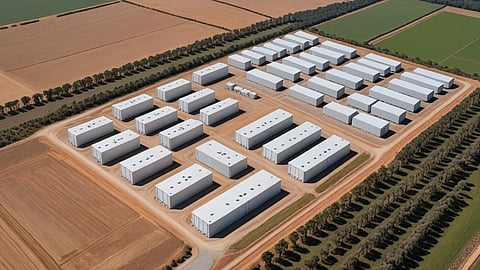


Large battery plants that are seeking a grid connection in Portugal will be required to form the grid and to supply synthetic inertia. The duty has been set by a government ordinance for BESS of 45 MW or more and for those that are connected at 110 kV or above, and it is applied to every new connection request.
Click here for a quick project snapshot
The Portuguese Government, a Lisbon-based national government, has made grid-forming capability and synthetic inertia mandatory for new BESS of 45 MW or more and for those connected at 110 kV or above. The duty has been laid down in Portaria No. 464-A/2026/1, an ordinance which was signed on 22 October 2026 by Jean Paulo Gil Barroca, the Deputy Secretary of State for Energy. It came into force on 23 October and applies to the connection requests filed since then.
The obligation has been graded by size, in the four classes of the European grid code (RfG). Type D plants must operate in grid-forming mode and must hold an energy reserve for synthetic inertia. For type C plants of 10 MW to 45 MW, grid forming applies on terms that the grid operator will set and where the grid capacity titles or tender documents call for it. Smaller plants must form the grid only where those documents ask for it.
The technical settings follow a joint report of ENTSO-E and industry bodies. Each plant is to keep power and energy in reserve for synthetic inertia. That reserve must answer frequency swings between 47.0 Hz and 52.5 Hz, and changes of up to 2 Hz per second. The plant's mechanical starting time, which fixes how much inertia it copies, can be set anywhere from 1 to 20 seconds. By default, the plant uses 12 seconds, and the reserve is sized on that figure. Power oscillations between 0.1 Hz and 10 Hz must be damped by at least 10%.
The ordinance also reaches beyond grid forming. Every plant of 500 kW or more must switch automatically from charging to discharging when the frequency falls. All but the smallest class must be able to take part in the balancing markets and to provide the frequency containment reserve as well as voltage control. Load changes outside reserve duty must follow a 10-minute ramp. Existing plants are covered only when an expansion or an equipment replacement amounts to a significant modification.
The rules have been set ahead of the revision of the European grid code because the government expects storage to grow quickly. The projects under the grid flexibility and storage notices of the Recovery and Resilience Plan add up to more than 1 GW, according to the ordinance. Sonnedix has closed the financing of its first hybrid projects in Portugal, with 24 MW of battery storage at Acail and 32 MW at Felgueiras, and ENGIE is building two 10 MW/45 MWh systems beside the Rallo and Mourisca wind farms for operation in 2027. Grid stability has been a pressing question in Iberia since the blackout that struck Spain and Portugal on 28 April 2025.