
News Synopsis
The Ministry of Heavy Industries (MHI) has invited global bids for the allocation of 10 GWh of Advanced Chemistry Cell (ACC) battery manufacturing capacity under the Production Linked Incentive (PLI) Scheme for ACC Battery Storage, marking the final allocation under the government's 50 GWh domestic manufacturing programme.
The global tender seeks eligible domestic and international manufacturers to establish giga-scale ACC manufacturing facilities dedicated to grid-scale stationary energy storage applications. Tender documents became available on July 15, 2026, while the pre-bid conference has been scheduled for July 29, 2026. Interested bidders must submit proposals by October 13, 2026, with technical bids to be opened on October 14, 2026.
The ACC PLI Scheme was approved by the Union Cabinet in May 2021 with a total financial outlay of INR 18,100 crore to establish 50 GWh of domestic ACC manufacturing capacity. Prior to this announcement, the government had already awarded 40 GWh of manufacturing capacity to domestic companies. The newly announced 10 GWh allocation completes the planned manufacturing target under the scheme.
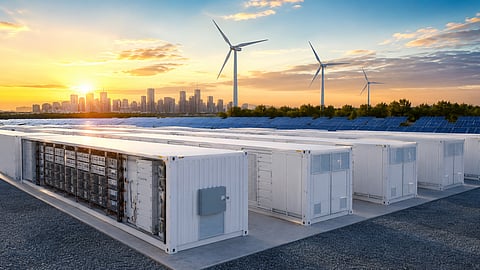
According to the Ministry of Heavy Industries, the newly tendered capacity has been earmarked specifically for grid-scale stationary battery energy storage systems, reflecting the growing need for large-scale energy storage as India rapidly expands renewable energy generation.
The government expects the additional manufacturing capacity to strengthen India's energy security by supporting the deployment of battery energy storage systems capable of integrating larger volumes of solar and wind power into the electricity grid. Increased domestic production is also intended to reduce dependence on imported battery cells while encouraging investment in advanced battery manufacturing technologies.
The PLI scheme is designed to attract both Indian and international manufacturers to establish globally competitive battery manufacturing facilities in the country. Besides supporting India's clean energy transition, the programme aims to develop an integrated battery manufacturing ecosystem, create industrial investments, promote technology transfer, and enhance supply chain resilience.
With the final 10 GWh capacity now open for competitive bidding, the government continues its efforts to position India as a major manufacturing hub for advanced battery technologies while supporting the country's long-term renewable energy and energy storage ambitions.