
EXECUTIVE SUMMARY
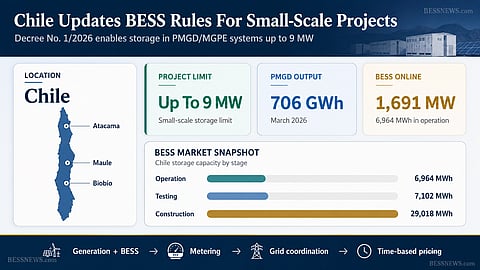
Chile’s Ministry of Energy has amended DS 88 to enable BESS in small-scale PMGD/MGPE projects of up to 9 MW. The updated regulation defines storage connection, metering, withdrawals and time-based pricing. The amendment supports grid coordination, customer supply priority and long-term storage use as Chile expands BESS deployment.
Click here for a quick project snapshot
Chile’s Ministry of Energy has amended the rules for small-scale distributed generation projects, allowing storage systems to be formally included in projects connected to the National Electric System.
The change was introduced through Decree No. 1/2026, published in the Official Gazette. The decree amends Supreme Decree No. 88 of 2019, which regulates Small Distributed Generation Facilities, known as PMGD, and other small-scale generation facilities.
The updated regulation expands the scope from small generation projects to small-scale generation and storage systems. The projects will now fall under the MGPE category, covering facilities with power surpluses of up to 9 MW.
The change allows batteries to be added to eligible distributed generation projects. Marcela Puntí, Director of Corporate Affairs at the Chilean Solar Energy Association, ACESOL, said the decree formally enables storage systems to be incorporated into this segment.
Distributed Generation Growth in Chile
The update comes as distributed generation continues to grow in Chile. According to a market report by Independent Energy Generators and Systep, PMGD projects injected 706 GWh into the National Electric System in March 2026, up 14.4% from the same month in 2025.
Small-scale generation now accounts for a measurable share of Chile’s electricity mix. In March, PMGD and Small Generation Plants or PMG, together accounted for 12.6% of total system generation. PMGD represented 9.6%, while PMG accounted for 3%.
Solar remains the main technology in the small-scale segment. Solar PMGD projects generated 629.8 GWh in March, while solar PMG projects generated 150.7 GWh. Installed PMGD capacity reached 3,523 MW, while PMG capacity totalled 402 MW nationwide.
The largest PMGD generation volumes came from O’Higgins, Metropolitana, Maule, Valparaíso, Coquimbo, Ñuble and Biobío. For PMG projects, the highest volumes came from Atacama and Maule.
New Rules For Storage Integration
Under the new decree, small-scale projects can combine generation and batteries, but they must follow rules on connection, operation, measurement and coordination. The regulation also recognizes both energy injections and energy withdrawals used to charge storage systems.
Owners or operators of MGPE assets synchronized with the system may sell evacuated energy at the instantaneous marginal cost or use the price stabilization mechanism. These owners may also sell surplus power at the node price of power.
Existing PMGD projects that want to add batteries will need to meet further technical conditions. The decree says technical regulations must define requirements for operating PMGDs, projects with a valid Connection Criteria Report and projects with an admissible Grid Connection Request.
These requirements will include studies, conditions for simplified procedures where applicable and minimum rules for withdrawals from the network for battery charging. Distribution companies will have a role in reviewing grid impacts and coordinating storage-related withdrawals.
Measurement And Customer Priority
Measurement is a key part of the updated framework. The decree calls for systems that can distinguish withdrawals for storage, the PMGD’s own consumption and withdrawals linked to end customers where relevant.
This separation is intended to avoid double counting and clarify energy and power balances. Costs linked to the operation and monitoring of PMGDs will be borne by the projects, in line with current rules.
The decree also gives priority to end customers over battery charging. Distributors must prioritize electricity supply to final customers before allowing withdrawals intended for PMGD storage.
Projects with batteries that withdraw from the grid will face more detailed connection evaluation. To qualify as a project with non-significant impact, a PMGD must meet capacity and injection requirements and must not withdraw energy for storage.
Pricing Changes Under the Decree
The decree also changes the remuneration model for PMGD projects under the stabilization mechanism. The previous stabilized price scheme will be replaced by a mechanism based on the Basic Energy Price or PBE, by time interval.
This pricing method values energy injections according to the time block in which they occur. For projects with BESS, the method may encourage stored energy to be discharged during periods when electricity has higher system value.
The decree introduces a monthly MEP Balance, calculated by the National Electric Coordinator. The balance compares the value of injections and withdrawals under the Basic Energy Price by time interval with the value of the same operations at marginal cost.
For storage, the coordinator must also account for the difference between withdrawals for battery charging valued at the PBE by time interval and their respective marginal cost. The accumulated annual balance will be repaid in twelve monthly instalments the following year, adjusted by the Consumer Price Index.
Withdrawals used for PMGD storage will not be treated as final consumption. This means energy used to charge batteries will not be subject to charges associated with end customers.
MGPE owners or operators must choose between selling energy at instantaneous marginal cost or using the stabilization mechanism. The choice must be submitted to the coordinator after the project is declared under construction and at least one month before operations begin.
Each pricing regime will have a minimum period of one year. A project owner seeking to change regime must give at least six months’ notice.
The decree includes a transitional regime for projects that had already opted into the existing scheme. According to Puntí, that regime will remain in place until July 2034 for those projects.
Some regulatory details are still pending. The Superintendency of Electricity and Fuels must request, within 90 days, a ruling from the Court for the Defence of Free Competition on the tariff regime for certain activities related to PMGD connection and operation.
Utility-Scale BESS Market Expands
Chile is also expanding storage at utility scale. According to the Chilean Renewable Energy and Storage Association, BESS technology had 1,691 MW and 6,964 MWh in operation as of May. A further 1,832 MW and 7,102 MWh were in testing, while 6,385 MW and 29,018 MWh were under construction.
Approved BESS projects reached 15,460 MW, with another 12,624 MW in the qualification process. Most projects under development are hybrid solar photovoltaic systems with battery storage.
For hybrid solar PV projects with BESS, Chile has 1,190 MW and 5,173 MWh in operation. Another 1,084 MW and 4,190 MWh are in testing, while 5,185 MW and 23,604 MWh are under construction.
Stand-alone systems also included 369 MW and 1,396 MWh in operation, 748 MW and 2,912 MWh in testing and 698 MW and 3,325 MWh under construction.
Supply Tender Recognizes BESS Backup
The regulatory update comes alongside Chile’s planned 2026/01 Supply Tender. The National Energy Commission has published preliminary terms for a tender covering 2,835 GWh per year to supply regulated customers from 2029 and 2030.
The process will return to 15-year contracts after the 2025/01 tender used four-year power purchase agreements. The procurement divides the tendered energy volume into two supply blocks.
The tendered energy volume is divided into two supply blocks: 1,575 GWh per year from January 2029 to December 2043 and 1,260 GWh per year from January 2030 to December 2044.
The formal call for bids is expected on July 1. Technical and administrative bids are scheduled for December 4, 2026, with financial bids planned for January 5, 2027, unless a second stage is required. The contract award is expected on January 13, 2027.
The tender terms also recognize BESS as valid backup assets for committed supply, provided the backup does not rely on coal, petcoke, diesel oil or fuel oil No. 6. For BESS, supply estimates must consider one daily charge and discharge cycle.
Chile’s updated DS 88 framework gives small-scale renewable projects a defined route to add batteries, while the 2026/01 Supply Tender recognizes BESS as a valid backup asset for long-term supply. Together, the measures set rules for storage across distributed projects and larger electricity supply commitments as renewable generation increases across the grid.