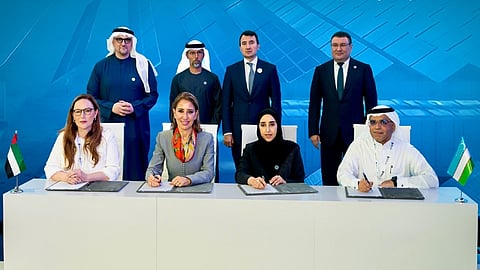

EBRD will invest up to USD 195.5 million to support a 300 MW greenfield solar PV project with a 75 MW/75 MWh battery energy storage system in Uzbekistan’s Kashkadarya region. Developed by Masdar-owned Nur Kashkadarya Solar, the project strengthens grid reliability, supports renewable integration, and advances Uzbekistan’s 2030 clean energy targets.
PROJECT SNAPSHOT
UK-based multilateral development bank,The European Bank for Reconstruction and Development (EBRD) has announced an investment of up to USD 195.5 million (€168.5 million) to support the development of a 300 MW greenfield solar photovoltaic plant with a 75 MWh battery energy storage system in Uzbekistan’s Kashkadarya region. The financing package includes an EBRD senior loan of up to USD 141.6 million along with a guaranteed facility of up to USD 25.0 million. These funds will be provided to Nur Kashkadarya Solar, a special-purpose project company wholly owned by Masdar, a global renewable and clean energy developer. The Asian Development Bank is expected to participate as co-financier, adding to the project's overall financial strength. To strengthen the project further, the EBRD is mobilizing concessional funding from international partners. This includes up to US$20.0 million from Canada and US$5.0 million from Finland under the Special Fund for the High Impact Partnership on Climate Action (HIPCA). In addition, the project will receive US$3.9 million from the Japan-EBRD Cooperation Fund in partnership with the EBRD. The solar power plant play a significant role in supporting Uzbekistan’s renewable energy development plan, which aims to develop 25 GW of solar and wind capacity by 2030. When completed, the plant is expected to generate approximately 664 GWh of electricity annually. This output will be sufficient to supply power to approximately 60,000 households while helping the country reduce annual CO2 emissions by up to 400,000 tonnes. A key component of the project is a 75 MW/75 MWh battery energy storage system integrated with the solar facility. The system enables energy dispatch during peak demand periods, manages variability in solar generation, and supports reliable grid operations as renewable capacity expands across Uzbekistan’s national power network. The EBRD has become a major supporter of Uzbekistan’s clean energy transfer. To date, the Bank has financed 1.65 GW of wind capacity, 2.4 GW of solar photovoltaic capacity, and 668 MW/1,837 MWh of battery energy storage systems across the country. Overall, the EBRD has invested almost US$6.8 billion in Uzbekistan through 204 projects. Most of the bank’s funding in the country directed toward private sector development. Uzbekistan has also been the largest recipient of EBRD funding in Central Asia for six consecutive years. almost US$6.8 billion in Uzbekistan to date across 204 projects, with most of the funds supporting private entrepreneurship. The country has been the leading recipient of EBRD funding in Central Asia for each of the past six years.