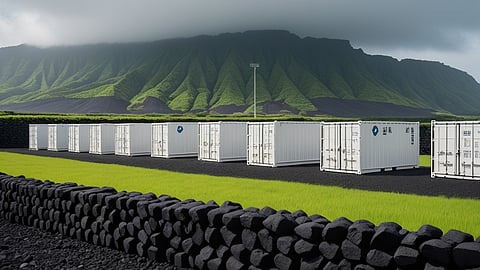


In South Korea, preferred bidders for 1,194 MW of battery storage at 14 sites were named on 26 November in the third round of the ESS central contract market, which had offered the largest volume to date. The final volume is to be confirmed on 4 December, and the plants must be completed by February 2029.
Click here for a quick project snapshot
The Ministry of Climate, Energy and Environment, a South Korea-based government ministry, has named the preferred bidders of its third ESS central contract market. The tender was held with the Korea Power Exchange (KPX). On 26 November it was made known that 1,194 MW of battery storage had been awarded, at 14 sites in four regions. The final volume will be fixed on 4 December, when talks with the bidders are over.
A total of 1,180 MW had been offered in this round, of which 1,100 MW was on the mainland and 80 MW was on Jeju. It was the largest volume to have been put out to tender so far, as storage was to be secured at an early stage. On the mainland, awards of up to 105% of the tendered volume, or 1,155 MW, were allowed, and 1,115 MW was awarded there.
By region, South Jeolla has been given the most. There, 539 MW is spread over six sites, which are tied to Haenam and four other substations. Five sites in North Jeolla hold 480 MW between them, and they are tied to Soseong and two more substations. Only one site, of 96 MW at Nonsan, was picked in South Chungcheong. Jeju's two sites, of 79 MW in all, are at Pyoseon.
Unlike the first two rounds, this one was not scored around a list of grid-management substations. The agencies concerned and outside experts looked instead at grid conditions in every part of the country. The need for storage at the point of connection and the gain in grid stability were what mattered most. Fire safety and industrial competitiveness kept their high weight.
The operators will then be held to two deadlines. Their generation business licences are due by August 2027. Their plants are due by February 2029. Another round, the fourth, is to be held in the first half of 2027, and it is meant by the ministry and KPX to serve the 100 GW renewable target and industries such as semiconductor fabs.
Minister Kim Sung-whan heads the ministry, whose Power Market Division handles the market. It was by the same ministry that a national guideline for the classification of outdoor BESS was issued in October. By that guideline, sealed units are to be treated as structures, and it is expected that their permitting will be shortened by up to three months.