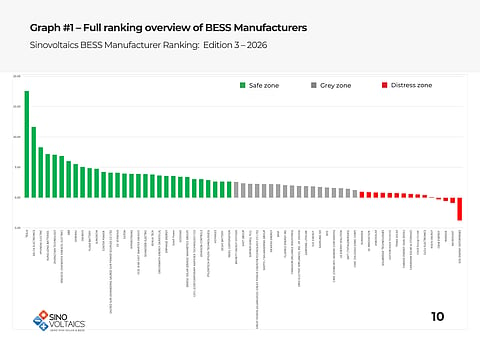

The latest financial stability assessment from Sinovoltaics ranked Tesla, Delta Electronics and Hyundai Electric as the top three energy storage manufacturers. The report also identified a widening financial gap between diversified industrial suppliers and pure-play battery, solar module and storage integration companies.
News Synopsis
Sinovoltaics, a Switzerland-based technical engineering company specializing in quality assurance, technical compliance and financial risk assessment for the renewable energy sector, has released the third edition of its 2026 Energy Storage Manufacturer Financial Stability Ranking. The report shows that diversified industrial companies continue to outperform pure-play battery, solar module and storage integration suppliers in terms of financial strength. It evaluates 65 energy storage manufacturers using the Altman Z-score model, which measures corporate financial stability based on profitability, liquidity, leverage, solvency and operational efficiency.
Tesla retained the top position in the latest ranking, followed by Delta Electronics and Hyundai Electric. The remaining companies in the top ten are Kung Long Batteries, Zhongtian Technology, Sinexcel, ABB, Generac, EnerSys and Yuasa Battery. According to the report, these companies demonstrated stronger balance sheets and greater resilience than many single-segment suppliers.
The study covers financial performance between September 2023 and June 2026. During this period, the number of manufacturers classified in the safe zone increased from 26 to 30 companies indicating moderate improvement across the sector. Eighteen companies were placed in the grey zone, while 17 remained below the 1.1 Z-score threshold associated with elevated bankruptcy risk over the following two years. Six manufacturers reported negative Z-scores, reflecting severe financial distress.
Diversified industrial and energy management companies recorded an average Altman Z-score of 5.54, well within the safe zone. This group includes Tesla, ABB, Delta Electronics, Eaton, Siemens Energy and GE Vernova whose revenues are generated from multiple business segments beyond battery storage. Inverter and power conversion system manufacturers also remained in the safe zone with an average score of 3.26.
Battery cell and battery pack manufacturers averaged 2.03, placing the segment in the grey zone. Solar module manufacturers averaged 1.13, reflecting continued pricing pressure and oversupply in the global photovoltaic market. Standalone battery storage integrators performed the weakest, averaging 0.08. Eos Energy Enterprises, Stem Inc. and ESS Tech remained in severe financial distress, although Eos improved its financial position despite remaining below a zero score.
The report also identified companies that improved their financial position during the assessment period. GE Vernova, Hyperstrong and SolaX Power moved from scores near zero into the safe zone, reflecting stronger balance-sheet performance.
According to Sinovoltaics, the ranking is intended to help project developers, EPC contractors, investors, financiers and procurement professionals evaluate supplier bankability and long-term warranty risks for battery energy storage system (BESS) projects. The company also publishes financial stability rankings for photovoltaic module manufacturers and PV inverter manufacturers.