
News Synopsis
PROJECT SNAPSHOT
Project Name – PowerBank-Nodiac modular data center development framework.
Developer – PowerBank Corporation and Nodiac Development.
Project Type – Solar, BESS and modular data center co-location.
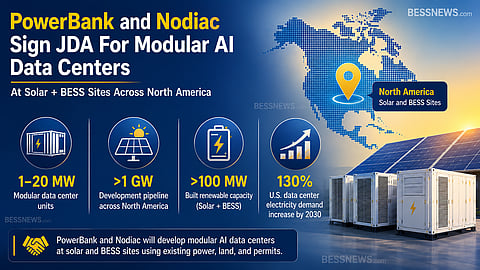
Capacity – Nodiac deploys 1–20 MW modular data center units; PowerBank has over 1 GW development pipeline.
Location – PowerBank sites across North America.
Technology Used – Modular, containerized data centers co-located with solar and BESS assets.
Project Status – Joint Development Agreement executed.
Timeline – LOI announced in April; JDA announced after PowerBank’s June 4, 2026 AI data center strategy update.
Purpose – Deploy AI compute infrastructure at renewable energy sites.
Expected Output – Faster data center deployment and new revenue streams from existing assets.
Agreement Details – Site-specific terms, permits, feasibility and financing are still required.
PowerBank Corporation, a North American independent energy company, has executed a Joint Development Agreement (JDA) with Nodiac Development, a developer of modular data center power infrastructure. The JDA establishes a framework to develop modular data centers at selected PowerBank renewable energy sites across North America. The agreement also provides a structured framework for the distribution of cash flow from these joint projects.
The new agreement builds directly on a Letter of Intent (LOI) announced in April between PowerBank and Nodiac.ai. Moving forward, the companies plan to use PowerBank’s existing solar and BESS sites for the deployment of distributed AI compute infrastructure. Under the JDA, PowerBank and Nodiac will continue to evaluate additional locations within the developer's portfolio.
The PowerBank sites currently under evaluation already hold generation capacity, access to additional power, land and necessary permitting approvals. Nodiac specializes in developing scalable, containerized data centers that can be co-located directly with these types of energy assets. Under this model, Nodiac deploys 1–20 MW modular data center units at distribution-level interconnection points. This decentralized approach is intended to bypass the multi-year transmission and large-load queues that typically delay traditional hyperscale data center construction.
The partnership comes amid unprecedented growth in electricity demand across North America, driven heavily by artificial intelligence workloads. In the United States, the International Energy Agency projects that electricity consumption from data centers will rise approximately 130% by 2030, accounting for nearly half of the country's total growth in electricity demand over that period.
A similar trend is unfolding in Canada. According to the Ontario Independent Electricity System Operator, the demand for electricity in the province is predicted to rise by 75% between now and 2050, reaching a level of 263 terawatt hours from the present day's 151 terawatt hours. Data centers that consume much energy are one of the fastest growing factors here.
Company leadership views the co-location model as a vital solution to these grid constraints. PowerBank CEO Richard Lu noted that the agreement moves the partnership from a shared vision to a defined development framework, allowing the company to unlock new value from its existing asset base. Nodiac CEO Robert Sher added that access to power remains the single biggest constraint in AI infrastructure today and utilizing pre-existing solar and BESS sites allows teams to bring compute capacity online in months rather than years.
With a development pipeline exceeding 1 GW and more than 100 MW of built renewable energy capacity, PowerBank's portfolio offers significant co-location potential. PowerBank is currently featured as a Speed-to-Power partner on Nodiac’s website. Actual construction at any selected site remains subject to the conclusion of definitive terms for that specific location, receipt of required permits, technical feasibility and final financing arrangements.