
News Synopsis
PROJECT SNAPSHOT
Project: North America BESS Proof-of-Concept Reference Platform
Capacity: Based on A123 587 Ah LFP prismatic cells
Location: North America
Developers: Dukosi Ltd, A123 Systems LLC, Nuvation Energy
Technology: LFP BESS, DKCMS® chip-on-cell monitoring, C-SynQ® communication, BMS/EMS integration
Configuration: 1P13S module design for ESS applications
Contract Type: Technology collaboration / Proof-of-Concept
Status: Proof-of-concept demonstration stage
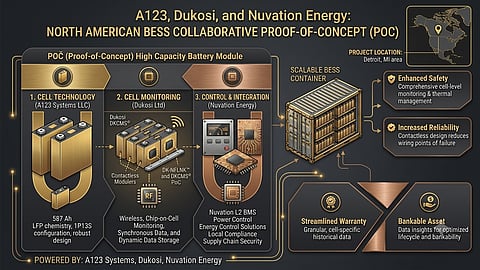
Dukosi Ltd, A123 Systems LLC and Nuvation Energy have unveiled a joint proof-of-concept (PoC) BESS designed to simplify large-scale deployments in North America. The reference platform integrates high-capacity lithium iron phosphate (LFP) cells with contactless, cell-level monitoring and localized battery management system (BMS) architectures to target utility-scale and data centre infrastructure.
The live demonstrator utilizes a standard 1P13S module configuration, pairing A123’s 587 Ah prismatic LFP cells with Nuvation’s Level 2 BMS. This hardware is managed by the Dukosi Cell Monitoring System (DKCMS), which features proprietary C-SynQ communication. When combined, these technological solutions will give the system integrators a blueprint for constructing large-scale systems that meet regional grid codes and also have long-term asset warranties.
As per Sandro Morero, Director of Engineering at A123 Systems LLC, such an effort is aligned with the company’s strategy to deliver high-capacity LFP systems for intensive battery installations. Morero pointed out that blending A123's fundamental chemistry knowledge with Dukosi's sensor chips and Nuvation's processing layout serves as a model for how cross-industry engineering can improve safety, reliability and serviceability across North American infrastructure.
North America's energy storage sector is expanding rapidly due to grid modernization, renewable energy targets and the strict uptime demand of artificial intelligence data centres. The partner companies designed this unified architecture to address these specific commercial needs by prioritizing localized supply-chain visibility and operational safety.
Focusing on these market requirements, Michael Worry, CEO/CTO at Nuvation Energy, emphasized that BMS and EMS controls serve as the critical electronic brain governing safety, performance and data tracking. Worry maintained that this vital intelligence needs to be engineered directly from the cell level up by regional experts who understand local market standards and security expectations. By matching North American-designed control electronics with smart cell technology, Worry explained that the architecture secures supply chains and satisfies regional cybersecurity compliance.
Commenting on the industry operational pressures driving this project, Joseph Notaro, Chief Revenue Officer at Dukosi, added that the collaboration delivers the safety and performance upgrades necessary for high-density modules in demanding grid environments. Notaro pointed out that advanced storage systems are vital for balancing power grids and supporting AI data hubs, where maintaining a "five nines" (99.999%) operational uptime is critical. He stated that implementing cell-level monitoring ensures these projects achieve superior voltage accuracy, deeper data insights and simplified long-term maintenance.
A core technical differentiator of the platform is the deployment of a dedicated Dukosi monitoring chip on every individual cell. Rather than using traditional, heavy wiring harnesses that are prone to connection failures, the system transmits voltage and temperature data wirelessly via a single near-field radio frequency bus antenna. This contactless design aims to improve mechanical reliability while drastically simplifying physical pack assembly.
On-cell data logging also alters the economics of long-term maintenance. Because each chip retains a permanent history of local thermal events and performance metrics, operators can easily validate warranty claims or conduct precise fault analyses. Also, the simplified architecture allows technicians to replace a single faulty cell during servicing, preventing the practice of scrapping entire multi-cell modules.
Ultimately, the PoC serves as a functional technology demonstrator for project developers navigating the dual pressures of regional cybersecurity compliance and escalating digital infrastructure power demands.Top of Form