
News Synopsis
Snapshot
Company - Eni Storage Systems is jointly owned by Eni Industrial Evolution and FIB, part of Seri Industrial Group.
Project - A new integrated Italian and European hub for lithium-iron-phosphate batteries.
Location - The Brindisi industrial site in Italy, within an area of the Versalis site.
Technology - LFP batteries for Battery Energy Storage Systems.
Capacity - 16 GWh per year by 2030 across Brindisi and Teverola.
Facilities - The plan includes battery cells, modules, BESS assembly, LFP cathode active material and recycling.
Market reference - European demand for these systems is expected to rise from 36 GWh in 2025 to around 138 GWh by 2030.
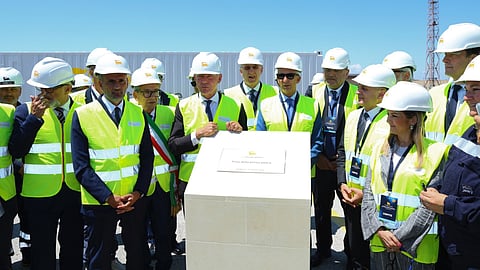
Eni Storage Systems, jointly owned by Eni Industrial Evolution and FIB of Seri Industrial Group, has started construction works at the Brindisi industrial site for a new hub to produce lithium-iron-phosphate batteries. The batteries are intended mainly for Battery Energy Storage Systems that support renewable energy deployment and grid stability. The work was launched in Brindisi, with Italy’s Minister of Enterprises and Made in Italy, Adolfo Urso, and local authorities attending the ceremony.
The Brindisi project is located in an area of the Versalis industrial site that was previously used for polymer storage and other decommissioned industrial activities. Eni describes the site as the first integrated hub dedicated to stationary battery production. The project forms part of the transformation of the Versalis site through Eni and Seri Industrial’s plan to develop energy storage systems.
The development plan includes a gigafactory in Brindisi for battery cells and modules and a Battery Energy Storage System assembly plant. The BESS assembly plant will have expanded capacity, allowing it to assemble battery modules supplied by Seri Industrial’s gigafactory in Teverola, in the province of Caserta. In a second phase, the Brindisi site will also add production of LFP cathode active material and battery recycling activities to serve the two gigafactories.
The project targets total production capacity of 16 GWh per year by 2030, with half of the capacity in Brindisi and half at the Teverola plant. Eni says this would equal more than 10% of the European market for stationary BESS. The release also cites Wood Mackenzie for expected European demand growth from 36 GWh in 2025 to around 138 GWh by 2030.
Giuseppe Ricci, Eni’s Chief Operating Officer for Industrial Transformation, said the project represents Eni’s entry into a new business and is intended to create industrial and technological value in energy storage. He also linked the investment to employment generation, strategic autonomy from non-EU markets and emissions reduction. Ricci said Eni’s parallel investment in FAENIX would support the marketing of storage systems produced in Teverola and Brindisi.
Vittorio Civitillo, Chief Executive Officer of Seri Industrial and FAENIX, said the initiative responds to industrial transformation by investing in a business linked to the energy transition. He said the project could create growth opportunities for Brindisi and Italy. The release does not disclose project investment value, construction completion timing or job numbers.