
News Synopsis
PROJECT SNAPSHOT
Focus: Spain’s electricity prices, renewable growth and BESS reforms
Published By: Ember
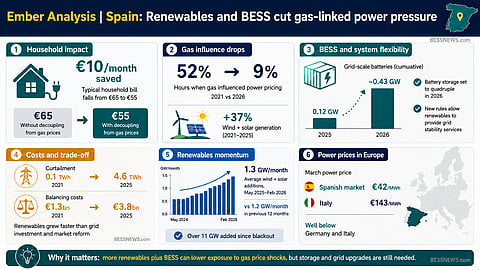
Main Finding: Spanish households saved about €10, or $11.60, per month since March 2026
Key Driver: Wind and solar growth reduced gas influence on power prices
Renewable Growth: Wind and solar generation rose 37% from 2021 to 2025
Gas Influence: Fell from 52% of hours in 2021 to 9% in early 2026
BESS Role: Large-battery capacity is expected to quadruple again in 2026
Grid Challenge: Curtailment and balancing costs increased as renewables grew
Significance: Storage, grid reforms and renewables may reduce exposure to gas price shocks
Ember, an energy think tank found that Spanish households have saved about €10, or approximately $11.60, per month on electricity bills since March 2026. The report linked the avoided costs to renewable capacity installed since 2021, which reduced the influence of gas prices on the Iberian electricity market after strong growth in wind and solar generation.
The country expanded renewable energy before the 2021–2024 gas crisis and continued this approach after the Iberian blackout of April 2025, a major power outage that affected Spain and Portugal. Spain’s wind and solar generation increased by 37% between 2021 and 2025, helping reduce the role of gas in electricity pricing.
Gas influenced power prices for about 52% of hours in 2021. In the first five months of 2026, that share fell to 9%. Ember said this shift helped keep electricity prices low despite higher European gas prices after geopolitical tensions involving the United States, Israel and Iran.
European gas prices rose by around 75% after the outbreak of the conflict and remained roughly 60% above pre-conflict levels at the beginning of June. The impact on electricity prices varied across markets, depending on how often gas-fired plants set wholesale power prices.
Spain and Portugal ranked among the three lowest EU countries for day-ahead electricity prices in each of the first four months of 2026. Italy, which Ember described as more dependent on gas, recorded average power prices of €143/MWh, or approximately $165.93/MWh, in March. That was three times higher than Spain’s €42/MWh, or approximately $48.74/MWh.
Ember estimated that if Spanish power prices were still linked to gas as strongly as in 2021, a typical household would have paid €10, or approximately $11.60, more per month for electricity since March 2026. This would represent a 19% increase. Most of the avoided cost came from wholesale electricity markets, where prices would have been higher under a 2021-like level of gas influence.
The report said avoided wholesale costs averaged about €15, or approximately $17.41, per month in March and April 2026. These savings were partly offset by higher balancing costs, estimated at €6 per month, leaving a net saving of about €10, or approximately $11.60, after tax.
Balancing costs have increased as wind and solar capacity grew ahead of grid investment and regulatory changes. According to Ember’s use of Red Eléctrica data, renewable curtailment rose from 0.1 TWh in 2021 to 4.6 TWh in 2025. Annual grid balancing costs also increased, moving from €1.3 billion, or approximately $1.51 billion, to €3.8 billion, or approximately $4.41 billion.
The analysis also noted that Spain has relied on conventional power plants, including gas plants, for grid balancing services. The reinforced operating model introduced after the April 2025 blackout added further stability requirements and increased the use of gas plants for grid support.
The Spanish government has introduced reforms to improve grid management and renewable integration. After the blackout, grid operating rules were changed to require renewable power plants to provide dynamic voltage control, a service previously supplied only by conventional plants. Ember said 6 GW of renewable capacity was already being used for voltage control services by May 2026.
In November 2025, the Spanish government also introduced emergency measures to support power system stability. These included planning changes to simplify the addition of battery storage to existing renewable energy facilities, alongside previously announced capital support for energy storage.
Renewable deployment continued after the April 2025 blackout. From May 2025 to February 2026, Spain added 1.3 GW of wind and solar capacity per month on average. In the previous 12 months, from May 2024 to April 2025, the monthly average was 1.2 GW.
Battery storage is expanding from a small base. Ember said Spain’s installed large-battery capacity quadrupled in 2025 and is expected to quadruple again in 2026.
Spain’s response to the 2026 energy crisis also included temporary electricity tax cuts. VAT on electricity was reduced from 21% to 10%, the special electricity tax was cut from 5.1% to 0.5%, and the tax on electricity generators was suspended. The first two measures removed about €8, or approximately $9.28, per month from a typical household bill before ending on June 1, 2026.
Ember said Spain’s experience links higher renewable generation, storage expansion, grid reforms and electrification measures with lower exposure to fossil fuel price shocks. The report connected these changes to lower electricity prices, improved renewable integration and reduced dependence on imported fossil fuels.