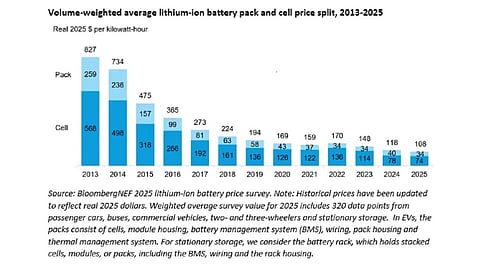

BloombergNEF’s 2025 Lithium-Ion Battery Price Survey indicates that average global lithium-ion battery pack prices declined 8% year-on-year, reaching a record low of $108/kWh. The reduction reflects continued manufacturing overcapacity, strong competition among suppliers, and wider use of lower-cost LFP chemistries. Stationary storage experienced the steepest decline, with prices falling to $70/kWh. Higher battery metal prices had limited impact, as costs were offset through LFP adoption, long-term contracts, and hedging measures.
DATA SNAPSHOT
New York-based energy research and analytics provider, BloombergNEF has reported a significant decline in global lithium-ion battery pack prices in its 2025 Lithium-Ion Battery Price Survey. The analysis showed that average battery pack prices fell 8% year-on-year to a record low of $108/kWh in 2025. The decline was registered primarily due to continued cell manufacturing overcapacity, intense competition and the ongoing shift to lower-cost lithium iron phosphate (LFP) batteries.
Battery metal prices increased in 2025 due to supply risks at certain Chinese lithium assets and new cobalt export quotas in the Democratic Republic of Congo (DRC). These increases did not result in higher annual prices for battery cells or packs. According to industry analysis, cost impacts were managed through increased of LFP adoption, long-term supply agreements, and expanded hedging strategies.
China has produced more battery cells than required for domestic electric vehicle and stationary storage demand, which the analysts say has created intense competition among manufacturers. This effect has been most visible in stationary storage sector, where many suppliers can serve the same utility-scale projects.
According to BloombergNEF’s battery price survey, the pricing differs across multiple battery end–use cases, includes different types of electric vehicles and stationary storage projects. Each sector requires different cell and pack specifications that resulted in varied pricing outcomes. The sharpest drop across all segments was seen in stationary storage as battery pack prices dropped to $70/kWh in 2025, 45% lower than in 2024, making it the lowest-priced segment for the first time. In the transport segment, Battery Electric Vehicles (BEV) packs were the cheapest at $99/kWh. This was the 2nd year their price was recorded under the $100/kWh threshold.
The average LFP battery pack prices across all segments were $81/kWh while nickel manganese cobalt (NMC) battery packs were $128/kWh, reflecting differences in chemistry and performance requirements.
The report showed China recorded the lowest average battery pack prices at $84/kWh, while North America and Europe were 44% and 56% higher. China also saw the largest price drop, at 13 %, compared with 4 % in North America and 8 % in Europe. Europe’s price decline was larger than North america’s due to US policy and tariffs. Many Chinese battery manufacturers redirected exports toward European markets, where pricing adjustments were implemented to maintain sales volumes and meet annual targets. This shift increased price competition within the European battery market.
BloombergNEF expects battery pack prices expected to decline further in 2026, as as wider adoption of LFP chemistries offset higher raw material costs.
Evelina Stoikou, head of BloombergNEF’s battery technology team and lead author of the report, stated that increased competition has contributed to continued declines in battery prices, supporting lower electric vehicle costs and wider deployment of grid-scale battery storage.