
News Synopsis
PROJECT SNAPSHOT
Project: Xiamen Energy Storage Validation Research Institute (ESVL)
Investment: RMB 3 billion (~US$440 million)
Location: Xiamen, China
Developer: Contemporary Amperex Technology Co. Limited
Technology: BESS validation and testing
Scale: 10-hectare testing campus
Key Capability: 35kV/100MVA grid simulator
Laboratories: Grid integration, high-voltage safety, combustion, environmental reliability, EMC
Status: Operational from May 28
Industry Focus: Real-world station-level energy storage validation
Contemporary Amperex Technology Co. Limited (CATL), a Chinese battery manufacturer and technology company, has officially launched operations at its Xiamen Energy Storage Validation Research Institute (ESVL), a large-scale testing and validation platform for BESS in Xiamen. The facility is intended to advance station-level validation standards for the global energy storage sector as deployment volumes continue to rise worldwide.
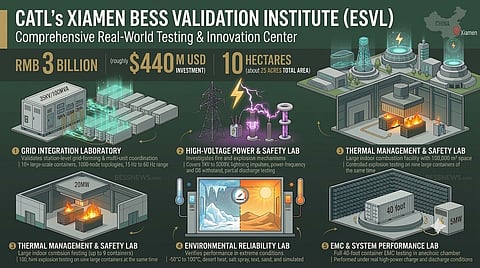
ESVL occupies about 10 hectares of land and represents an investment of roughly RMB 3 billion ($440 million). This platform will be used as a common facility that will facilitate battery makers and project developers to carry out system-level validation. The launch comes as the energy storage industry faces increasing scrutiny over operational performance and grid integration challenges.
Based on industry statistics, almost 20% of all utility-scale energy storage facilities worldwide underperform and roughly 45% of energy storage systems have grid connection delays of more than two months. Existing validation processes within the industry rely mostly on individual component testing as well as scenario testing, thereby necessitating station-level testing under real-world operating conditions.
The ESVL platform is designed to shift testing from individual components to full-system and station-level validation, covering areas such as operational safety, grid-support functionality and long-term reliability before projects are commissioned.
Dr. Wu Kai, Chief Scientist at CATL, stated that scientific validation has become increasingly critical as the energy storage market enters the gigawatt-scale deployment phase. He noted that the facility is designed to improve testing discipline, reflect real grid conditions and raise quality standards by moving validation earlier in the project delivery cycle.
The institute was developed in cooperation with international certification organizations including TÜV SÜD, TÜV Rheinland, the China General Certification Centre and CSA Group. The facility offers “one-test, multi-witness” validation services intended to support internationally recognized certification processes.
The research institute is organized around five dedicated laboratories targeting grid integration, high-voltage safety, combustion testing, environmental reliability and electromagnetic compatibility.
The infrastructure includes a grid integration laboratory on the station level. The testing platform is equipped with a grid simulator featuring a 35 kV/100 MVA capacity and a real-time simulation system that enables the simultaneous verification of more than 10 large-scale battery storage units. The laboratory is capable of simulating grids with 1,000 nodes and validating the grid-forming capabilities and coordination of multiple units.
The High-Voltage Safety Laboratory covers testing ranges from 1 kV to 500 kV and is intended to study fire and explosion mechanisms under extreme electrical conditions, including lightning impulse and DC withstand testing. The laboratory will support the identification of operational safety limits for both individual components and complete storage systems.
The facility also features a Thermal Safety and Combustion Laboratory, which includes a calorimeter of 20 MW and a combustion volume of 100,000 cubic meters. This facility can conduct combustion and explosion tests simultaneously for up to nine utility-scale battery storage systems to provide data for spacing between units, system designs, and fire prevention measures.
The Environmental Reliability Laboratory will be utilized for testing storage systems in challenging environments where the temperature may vary from -50°C to 100°C, alongside high-altitude simulation at 7,200 meters. The lab tests systems that experience tough environmental conditions such as desert and high-salinity environments.
Meanwhile, the Electromagnetic Compatibility Laboratory has the ability to facilitate the placement of complete battery containers, measuring 40 feet in length, during high-power charging and discharging processes. This lab facilitates real-condition interference tests with the intention of ensuring improved communication reliability.
The combination of station-level testing capabilities and environmental simulation is intended to provide verifiable validation data for large-scale energy storage deployment as electrical grids increasingly rely on battery systems for renewable energy integration and grid stability.