
News Synopsis
China has rapidly built the world's largest battery energy storage system (BESS) fleet, but a new analysis by Ember suggests the country's next challenge is improving battery utilisation rather than simply adding more capacity. According to the report, China's utility-scale batteries could have shifted an additional 23 TWh of clean electricity during 2025 if operated closer to their technical potential.
China's battery storage expansion has been unprecedented. In December 2025 alone, the country commissioned 18.76 GW/65.46 GWh of new energy storage capacity which is exceeding the total annual additions made by the United States during the same year. By the end of 2025, China accounted for more than half of global battery energy storage capacity while installed lithium-ion BESS capacity approached 150 GW by the first quarter of 2026. The government has also increased its national target for new energy storage to 300 GW by 2030.
The report notes that early growth in China's battery storage sector was largely driven by mandatory renewable energy co-location policies, requiring wind and solar projects to include battery storage. These systems helped reduce renewable energy curtailment but generally operate under fixed dispatch patterns and have limited participation in electricity markets.
Policy reforms are now reshaping the sector. Document 136 ended the national renewable energy storage co-location mandate in February 2025, while Document 114 introduced nationwide capacity remuneration for standalone battery storage beginning in January 2026. As a result, standalone battery systems now receive stronger market signals and can participate more actively in grid operations.
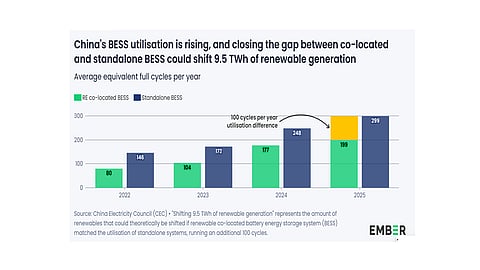
Battery utilisation has improved significantly more than doubling between 2022 and 2025. However, Ember found that renewable co-located systems still complete roughly 100 fewer annual charge-discharge cycles than standalone batteries.
Closing that utilisation gap alone could enable renewable co-located batteries to shift an additional 9.5 TWh of electricity each year. Under an optimised scenario where both co-located and standalone systems achieve 350 annual cycles, China's battery fleet could shift 23 TWh more clean electricity, equivalent to powering Singapore's economy for approximately five months.
The report also highlights a changing market structure. Between January and April 2026, standalone battery projects represented 84.7% of newly installed utility-scale storage capacity while renewable co-located systems accounted for only 8.4%.
Ember concludes that future growth will depend on stronger electricity market reforms, expanded ancillary service participation, capacity payments, joint market clearing and revenue stacking mechanisms that allow battery storage assets to capture the full value they provide to China's increasingly renewable-based power system.