
News Synopsis
PROJECT SNAPSHOT
Project: Voltus acquisition of Brightfield AI
Sector: Commercial and industrial energy storage
Technology: BESS, VPP, DER platform, AI battery modeling
Location: United States
Buyer: Voltus, Inc.
Acquired company: Brightfield AI
Deployment focus: C&I customer sites, including hyperscalers and large energy users
Status: Acquisition announced
Purpose: Reduce time and cost for C&I battery storage deployment
Key benefit: Supports energy cost management, grid flexibility and faster BESS project
Voltus, Inc., a US-based virtual power plant operator and distributed energy resource platform, has acquired Brightfield AI to expand commercial and industrial BESS deployment across the United States.
The acquisition adds Brightfield AI’s battery project development platform to Voltus’s existing distributed energy resource business. Brightfield focuses on reducing the time and cost involved in assessing, developing and deploying commercial and industrial energy storage projects. The company works with engineering, procurement and construction partners to support battery deployment at customer sites.
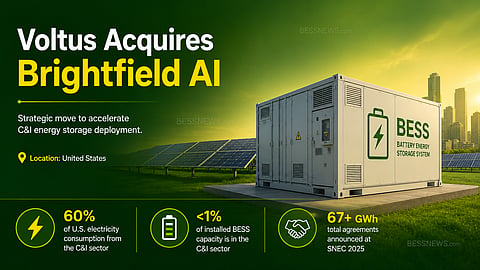
Voltus said the transaction is aimed at addressing a largely undeveloped segment of the US storage market. Commercial and industrial customers account for about 60% of total US electricity consumption, but currently host less than 1% of installed battery energy storage system capacity. The company sees this gap as a significant opportunity for behind-the-meter storage, demand flexibility and grid support.
The combined platform is expected to support site evaluation, customer acquisition, battery modelling and early-stage project development. Brightfield’s AI-based modelling and optimization tools will be used to assess the readiness of customer portfolios and automate development workflows. This is intended to help Voltus identify storage opportunities across its network of commercial and industrial facilities.
Voltus CEO Dana Guernsey said the combination of the two companies would allow Voltus to bring more cost-effective storage options to customer sites. In her view, Brightfield’s project execution experience and industry relationships strengthen Voltus’s ability to respond to rising energy cost concerns among commercial and industrial energy users.
Brightfield AI’s leadership will also take on senior roles within Voltus. Tim Hade, CEO of Brightfield AI and co-founder of Scale Microgrids, will join Voltus as senior vice president of its battery division. Larsh Johnson, co-founder of Brightfield AI and former CTO of Stem, Inc., will become Voltus’s chief technology officer. Johnson previously led the development of Athena, Stem’s AI-enabled battery optimization platform. Neil Lakin, co-founder and CTO of Voltus, will move into the role of chief architect. Oleksandr Vovk, president of Brightfield AI, will serve as vice president of BESS and lead the buildout of Voltus’s AI-native battery deployment platform. Peter Krasco, COO of Brightfield AI, will become vice president of battery operations.
Larsh Johnson, Co-Founder of Brightfield AI, said the transaction gives the company access to Voltus’s commercial and industrial customer base, existing EPC partnerships and market position in distributed energy resources. Additionally, the corporation is planning to collaborate with battery makers, financiers, commercial and industrial consumers, and hyperscale clients who need capacity from the Voltus Bring Your Own Capacity (BYOC) service, which works around grid limitations by installing and earning from local energy storage systems.
The deal comes at a time when utilities and large-scale electricity consumers are searching for sources that can provide greater flexibility in dealing with peak demand and ensuring greater reliability through the use of renewable sources. According to Voltus, its technology allows flexible load, distributed generation, energy storage, energy efficiency and electric vehicle technologies to be connected to electricity markets, enabling its commercial and industrial clients to generate revenue from these assets. The companies did not disclose a transaction timeline or near-term deployment targets.