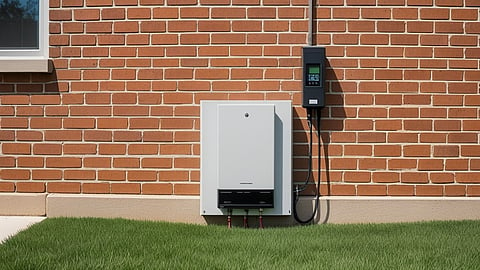


A residential battery program in North Texas, under which 75 MW of batteries have been installed in the homes of CoServ members since March, is to be expanded to 450 MW. Base Power, which installs and maintains the batteries, has been adding about 10 MW a month to the fleet that the cooperative dispatches at peak demand.
Click here for a quick project snapshot
Base Power, a US-based energy company headquartered in Austin, Texas, and Denton County Electric Cooperative (CoServ) have announced that their residential battery program is to be expanded to 450 MW. Since the program was launched in March, Base has installed 75 MW of batteries at the homes of CoServ members in North Texas, United States.
Each of those batteries has been put to two uses. It supplies the whole home with backup power during an outage, and it also forms a part of a networked fleet that CoServ dispatches during peak demand. Base installs and maintains every battery, while the cooperative controls when the fleet is charged and discharged.
So far the fleet has grown by about 10 MW a month, a pace that the companies have called much faster than other resources can be built. For CoServ, the third-largest electric cooperative in the United States, speed counts, as it serves more than 300,000 electric members in a fast-growing area that takes in parts of Denton, Collin and surrounding counties.
When we launched this program, we saw distributed batteries as an opportunity to add flexible capacity while creating meaningful value for our Members. The adoption we’ve seen in just a matter of months reinforces that opportunity. Expanding the program allows us to build on that momentum and create an even larger resource that benefits participating Members and the broader CoServ system.
Gary Franzen, Chief Energy Resources Officer of CoServ
The expansion has come at a time when Base is growing in Texas and beyond. The company has recently announced a strategic partnership with Walmart, under which Base is to be offered at select Walmart and Sam’s Club stores in Texas. It has also signed its first utility partnership outside Texas, with Central Georgia Electric Membership Corporation (Central Georgia EMC), for 50 MW of residential battery storage.
The program is being built in a state in which battery storage has grown quickly. Texas had 33.1 GWh of battery storage by the summer of 2026, up from 1.0 GWh in 2021, according to an analysis by the Solar Energy Industries Association (SEIA). Across the United States, residential storage installed 676 MW in Q2 2026, which was its fourth-largest quarter on record, according to Wood Mackenzie and the American Clean Power Association.