
News Synopsis
PROJECT SNAPSHOT
Analysis: India solar curtailment and BESS flexibility
Source: Ember
Focus: Coal flexibility limits and renewable back-down
Key figure: 2.1 TWh unused renewable electricity in FY 2025–26
Storage need: Around 10 GWh of BESS charging during midday surplus hours
Grid issue: Coal plants cannot reduce output below minimum technical load
Locations cited: Delhi and Gujarat, India
Projects cited: Kilokari BESS and Khavda BESS
Status: Analysis-based grid flexibility finding
Purpose: Reduce renewable back-down and improve grid balancing during high solar output
Ember, the energy think tank, said India’s growing solar fleet is beginning to test the flexibility of the country’s coal-based power system. The analysis found that solar and wind generation is rising fastest during midday hours, when coal plants are already being pushed close to their minimum operating levels.
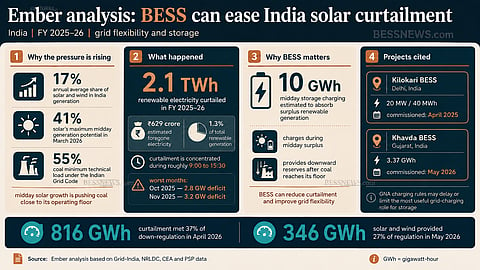
The analysis estimates that India curtailed 2.1 TWh of renewable electricity in FY 2025–26 because coal plants could not reduce output below their minimum operating level. The think tank valued this unused electricity at about INR 629 crore, equal to nearly 1.3% of total renewable generation.
The challenge comes from how India’s grid is balanced during periods of high solar output. Solar and wind supply around 17% of India’s electricity generation on an annual average basis, but the combined share can rise much higher during midday. In March 2026, solar’s maximum midday generation potential reached 41% of total generation, up six percentage points in one year.
Coal remains the main source of flexibility for India’s grid, providing most upward and downward regulation services used to balance supply and demand in real time. In March 2026, coal supplied 1,351 GWh of regulation up out of 1,364 GWh and 1,984 GWh of regulation down out of 2,395 GWh.
Coal’s grid-balancing flexibility has a limit. Coal plants cannot be pushed below their minimum technical load, which the report places at 55% of rated capacity under the Indian Grid Code. Since April 2026, coal has been required to generate below this level in more than half of midday dispatch intervals, leaving less room for further downward regulation.
When coal cannot reduce output further, renewable generation is backed down to maintain grid balance. Ember said renewable back-down accounted for 37% of down-regulation in April 2026, equal to 816 GWh. The same contribution was almost negligible in April 2025. Solar and wind also provided 27% of regulation in May 2026, or about 346 GWh.
The report said the reduction is concentrated in solar hours, generally between 9:00 and 15:30. At the most constrained half-hour periods, 5–6% of solar and wind generation was displaced because coal could not operate any lower. The pressure was highest in October and November 2025, when the grid lacked 2.8 GW and 3.2 GW of flexibility, respectively, to keep coal above its minimum operating level.
BESS could reduce this pressure by charging during midday surplus periods. Ember estimated that around 10 GWh of storage charging during the midday window would have been enough to absorb surplus renewable generation, keep coal plants above minimum technical load and avoid much of the unused electricity seen in FY 2025–26.
The analysis said storage can support the grid in two ways. BESS can create demand during surplus solar hours by charging from generation that might otherwise be backed down. It can also provide downward reserves once coal plants have reached their operating floor.
Ember said deployment speed is not the main barrier. The report cited the 20 MW / 40 MWh Kilokari BESS in Delhi, commissioned in April 2025, and the 3.37 GWh Khavda BESS project in Gujarat, commissioned by Adani Green Energy in May 2026 within ten months of construction starting on site.
The report identified connectivity rules as a key concern for storage use. Under the General Network Access framework, some BESS projects seeking non-solar-hour access must install commensurate renewable generation capacity for charging. Ember said this can delay projects and limit the ability of batteries to charge from grid surplus during solar hours, even when that charging could reduce wasted renewable output.
The analysis said grid charging during surplus renewable periods should be treated differently from drawing power during constrained non-solar hours. Batteries that charge when renewable generation would otherwise be unused can reduce system stress and improve grid flexibility.
The findings show that India’s next phase of renewable energy growth will depend not only on adding solar and wind capacity, but also on improving grid flexibility. Storage, scheduling rules and connectivity conditions will shape how much renewable electricity can be used during high-output periods.