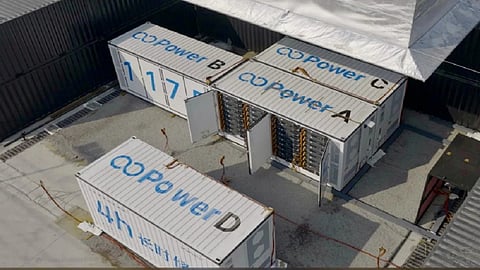

HiTHIUM has completed the world’s first open-door large-scale fire test of a 6.25 MWh long-duration energy storage system (LDES) using kWh battery cells. Conducted under UL 9540A (2025) and NFPA 855-2026 requirements, the test validated controlled energy release, fire containment, and structural integrity under extreme conditions, supporting safer deployment of higher-capacity LDES systems.
PROJECT SNAPSHOT
China-based Battery energy storage manufacturer, HiTHIUM, has completed an open-door large-scale fire test of its ∞Power 6.25 MWh, 4-hour long-duration energy storage (LDES) system equipped with kAh battery cells.
According to the company, the test was conducted under full supervision from UL Solutions, U.S. Authorities Having Jurisdiction, and Fire Protection Engineers, and followed the latest requirements of UL 9540A (2025) and NFPA 855 (2026).
The validation focused on system-level safety performance at higher energy densities using HiTHIUM’s ∞Cell 1175 Ah battery cells. The company described the test set up as “open-door combustion”, where the container doors were left open to maximize oxygen supply and flame exposure. Adjacent battery containers were positioned back-to-back and side-by-side with about 15 cm spacing, operating at full charge without active fire suppression.
The test evaluated three core safety aspects across the cell, module, and system levels. For controlled energy release, the battery system incorporated directional venting through a three-dimensional airflow channel, supported by dual pressure relief valves at the module level. This configuration allowed gas release without pressure buildup, and no explosions or debris ejection were recorded during the test.
Thermal containment was assessed under direct flame exposure and high heat transfer conditions. Fire-resistant module covers, reinforced steel enclosures, and insulated multi-layer container structures were used to limit thermal propagation. According to test observations, combustion remained confined to the affected battery system, and temperatures in adjacent containers stayed below defined safety thresholds.
Structural resistance was also evaluated during prolonged exposure to high temperatures. The ∞Power 6.25 MWh system featured a reinforced steel frame, structural stiffeners, and dual-layer internal partitions. Following continuous combustion, the container structure remained intact, with no major deformation or collapse observed.
This test builds on HiTHIUM’s earlier open-door fire test of a 5 MWh energy storage system and extends safety validation to higher-capacity configurations. The results provide system-level safety data for LDES installations using ultra-large-capacity battery cells under worst-case operating scenarios.
The company said that as energy storage capacities move beyond 5 MWh, such tests provide reference data for safety assessment, regulatory compliance, and deployment planning, while LDES remains a priority with further testing planned as capacities scale.