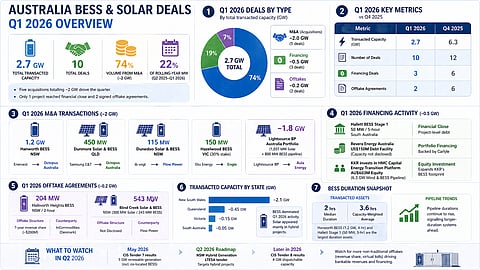

Modo Energy’s Q1 2026 report found that Australian BESS and solar deal activity slowed in financing and offtake agreements, while acquisitions remained strong. Five acquisitions totaling nearly 2 GW dominated activity, led by the 1.2 GW Hanworth BESS deal. Overall, 2.7 GW across 10 transactions highlighted continued investor confidence in Australia’s renewable and battery storage market.
PROJECT SNAPSHOT
Market: Australia National Electricity Market (NEM)
Focus: Battery Energy Storage Systems (BESS)
Capacity: ~5 GW / 11 GWh operational (2025)
Pipeline: ~10 GW expected in next two years
Key Trend: Shift from FCAS to energy arbitrage revenue
Technology Shift: Increasing adoption of 4-hour batteries
Investment Model: Hybrid revenue (merchant + contracts)
Challenge: Margin compression due to rising competition
Australia’s National Electricity Market (NEM) is witnessing a rapid growth and changes in BESS investments in Q1 2026 reports. These reports highlight significant shifts in project financing, acquisitions and offtake strategies. On an analysis, the market is transitioning from early-stage deployment to a more mature investment landscape driven by changing revenue structures and increasing competition.
One of the key trends is the growing reliance on energy arbitrage as the primary revenue source for battery operators. As there is a decline in returns from saturated FCAS markets, this makes energy price spreads as the primary source of returns.
Five acquisitions, totalling nearly 2 GW, significantly reshaped ownership of BESS and solar assets in Australia. In contrast, only one standalone project reached financial close, while just two secured offtake agreements. Totally around 2.7 GW was transacted across 10 deals.
Amid slower financing activity, five acquisitions in Q1 2026 totalled nearly 2 GW of solar and battery storage assets. This rises to around 3 GW when including Aula Energy’s acquisition of Lightsource BP’s Australian portfolio, which includes 1,037 MW of operating solar and 800 MW of development-stage BESS.
Other key deals saw Octopus Australia acquire the 1.2 GW Hanworth BESS in New South Wales from Enervest. Dunmore Solar and BESS project (450 MW, Queensland) was purchased from Samsung C&T. Flow Power acquired the Dunedoo Solar and BESS project (115 MW, New South Wales) from ib vogt. Additionally, Engie took complete control of 150 MW Hazelwood BESS in Victoria by purchasing the remaining 30% stake from Eku Energy.
In terms of investment, KKR committed AU$603 million to HMC Capital’s Energy Transition Platform, which supports a 6.3 GW pipeline of wind and battery storage projects. This expands KKR’s presence into utility-scale BESS in Australia.
Investment strategies are shifting toward longer-duration battery systems. Capacity-weighted duration better reflects the trend of increasing BESS durations, highlighting the shift toward longer storage systems. This trend becomes even more pronounced when focusing on newer projects. For example, the 1.2 GW Hanworth BESS—the largest transacted asset—is a four-hour system, while Hallett BESS Stage 1, the only project to reach financial close, features a five-hour duration.
Q1 2026 saw more activity in asset ownership than in project-level progress, with limited movement in contracting and financing. Q2 will be key in determining whether this deal activity translates into project advancement.
Several upcoming milestones could support this shift. CIS Tender 7 results, expected in May, will award 5 GW of renewable capacity across the NEM, much of it likely to include co-located BESS. New South Wales’ Hybrid Generation LTESA will also feature in the Q2 Roadmap Generation Tender, targeting hybrid projects that have struggled to reach financial close.
At the same time, offtake structures are continuing to evolve. The Bellambi Heights revenue-sharing model with InCommodities signals a move away from traditional PPAs, physical tolling, and government-backed contracts. The coming quarters will indicate whether these new structures can improve bankability and accelerate project financing.
In overview, Q1 2026 marks a transition phase for Australia’s BESS market. Scale, technology selection and revenue optimization are becoming key to long-term success.